
This post contains affiliate links. If you buy through them, DumbSwitches may earn a commission at no extra cost to you. See our full disclosure.
The Blink Sync Module 2 is the small white hub that lets a group of Blink cameras share one wifi connection and (more importantly) record clips to a USB drive instead of forcing you onto a paid Blink subscription. If you own an Outdoor 4, an XT2, or an older Indoor/Outdoor camera, you need one. Mini, Mini 2K+, Wired Floodlight, and Video Doorbell can run without it – but if you want local storage on any of those, you still need one.

Last updated: May 2026. Verified against Blink’s official Sync Module requirements and Sync Module 2 FAQ.
TL;DR – which Sync Module do you actually need?
- Sync Module 2 – the workhorse. ~$40, USB-A port up to 256GB, ~100ft range. The default pick for almost everyone.
- Sync Module XR – released late 2024. microSD slot instead of USB-A, plus a proprietary 900MHz radio that reaches up to 250ft (XR mode) or 400ft (XR+ mode) – but the extended range only works with up to two Outdoor 4 cameras per hub, and only in the US/Canada.
- Original Sync Module (gen 1) – still supported, no local storage, no reason to buy one new. If yours works, leave it.
- No Sync Module at all – fine if you only own Mini 2K+ cameras (or Mini 2), a Wired Floodlight, a Video Doorbell, or 3rd-gen Indoor/Outdoor units, AND you’re happy paying for a Blink subscription for cloud clips.
What is a Blink Sync Module 2?
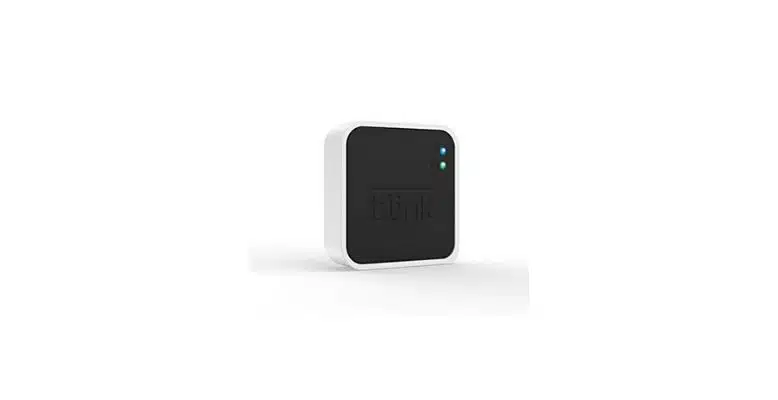
The Sync Module 2 is a small white plastic puck (3.2 x 3.2 x 0.8 inches) that plugs into a wall outlet via USB. It does two jobs. First, it acts as the local hub that older Blink cameras talk to instead of pinging your wifi directly – which saves their AA batteries and gives them faster wakeup times. Second, and this is the part that actually matters in 2026, it has a USB-A port on the side. Plug a flash drive in and your motion clips get saved there, locally, with no subscription required.
That second feature is the entire reason this product still exists. Blink’s Basic plan is $3.99/month or $39.99/year per camera, and Plus is $11.99/month or $119.99/year for unlimited cameras. The Sync Module 2 costs about the same as one year of Basic for one camera – and after that, it’s free.
Do I need a Sync Module? It depends on your camera
Blink quietly changed which cameras require a hub a few years back, and the old answer of “yes, you always need one” is no longer correct. Here’s the current rule, straight from Blink support.
Cameras that require a Sync Module
- Outdoor 4
- XT2 (older battery outdoor)
- XT (the original)
- Indoor 1st gen
Cameras that work without one
- Mini and Mini 2K+ (wired, talk straight to your wifi)
- Wired Floodlight Camera
- Video Doorbell
- Indoor and Outdoor 3rd generation
- Blink Arc (two Mini 2K+ cameras on a single mount – wifi only)
Catch is, all five of those “no-hub-required” cameras still need either a Sync Module or a Blink subscription to save clips anywhere. Wifi alone gets you a live view and nothing else. So unless you’re happy paying monthly forever, the answer for most setups is still: buy the module.
Sync Module 2 vs Sync Module XR vs the original
The original Sync Module (gen 1) is the one shipped in early Blink starter kits before 2020. It has no USB port, no local storage, and no good reason to exist now that the 2 is cheap. Both gen 1 and gen 2 handle up to 10 cameras per hub.
The Sync Module XR (late 2024) is the newer big sibling. Three things changed:
- Storage moved from USB-A to microSD. Still up to 256GB. exFAT format. Same idea, smaller card.
- Power is now USB-C instead of micro-USB.
- Optional 900MHz extended-range radio for compatible cameras. XR mode reaches up to 250 feet at 1080p. XR+ mode reaches up to 400 feet but drops to 720p and kills two-way audio.
Big caveat on that range claim: the extended-range feature only works with up to two Outdoor 4 cameras per XR hub, and only if you live in the US or Canada. If you’ve got an Outdoor 3rd gen, a Mini, or anything else, you’re back to standard 2.4GHz wifi at roughly 100 feet – same as the Sync Module 2. So unless you specifically need to push two Outdoor 4 cameras into a far corner of a large property, the XR isn’t doing anything the cheaper Sync Module 2 won’t.
The subscription dodge – why Sync Module 2 is the smart buy
Here’s the math nobody at Blink wants to spell out. A Sync Module 2 plus a 128GB USB drive costs around $50 once. A Blink Plus subscription costs $119.99 every year, forever, for as long as you own those cameras. Over five years that’s $599 vs $50.
What you give up by going local-storage-only:
- Cloud access from outside your home network (clips live on the USB drive, not on Blink’s servers)
- Person and vehicle detection (subscription-only smart alerts)
- Extended live-view sessions (capped at 90 seconds without a plan)
- 10% off Blink devices on Amazon
If you mostly just want a record of what happened in case someone steals a package or your fence catches fire, local storage is plenty. If you want push notifications that say “person detected” instead of “motion detected” – or you want to scrub through 60 days of cloud history from a beach in Thailand – pay the subscription.
USB drive specs that actually matter
This is where people waste money. Blink’s specs are strict and weirdly narrow.
- Capacity: between 1GB and 256GB. Bigger than 256GB will not be recognized. There’s no clever 1TB-with-partitions hack that works reliably.
- Format: exFAT preferred (the module will reformat to this automatically, wiping the drive). FAT32 and FAT also work.
- Connector: Type-A, self-powered (no external power needed).
- Free space minimum: 375MB. Drop below that and the module stops recording.
- Speed: at least 10 Mbps read/write. Any modern USB 3.0 drive clears this easily.
A plain 128GB or 256GB SanDisk Ultra Flair (USB 3.0) is the safe pick. Don’t get exotic. Don’t get a 1TB drive thinking you can split it. Just buy a 256GB stick and forget about it.
How to set up a Blink Sync Module 2
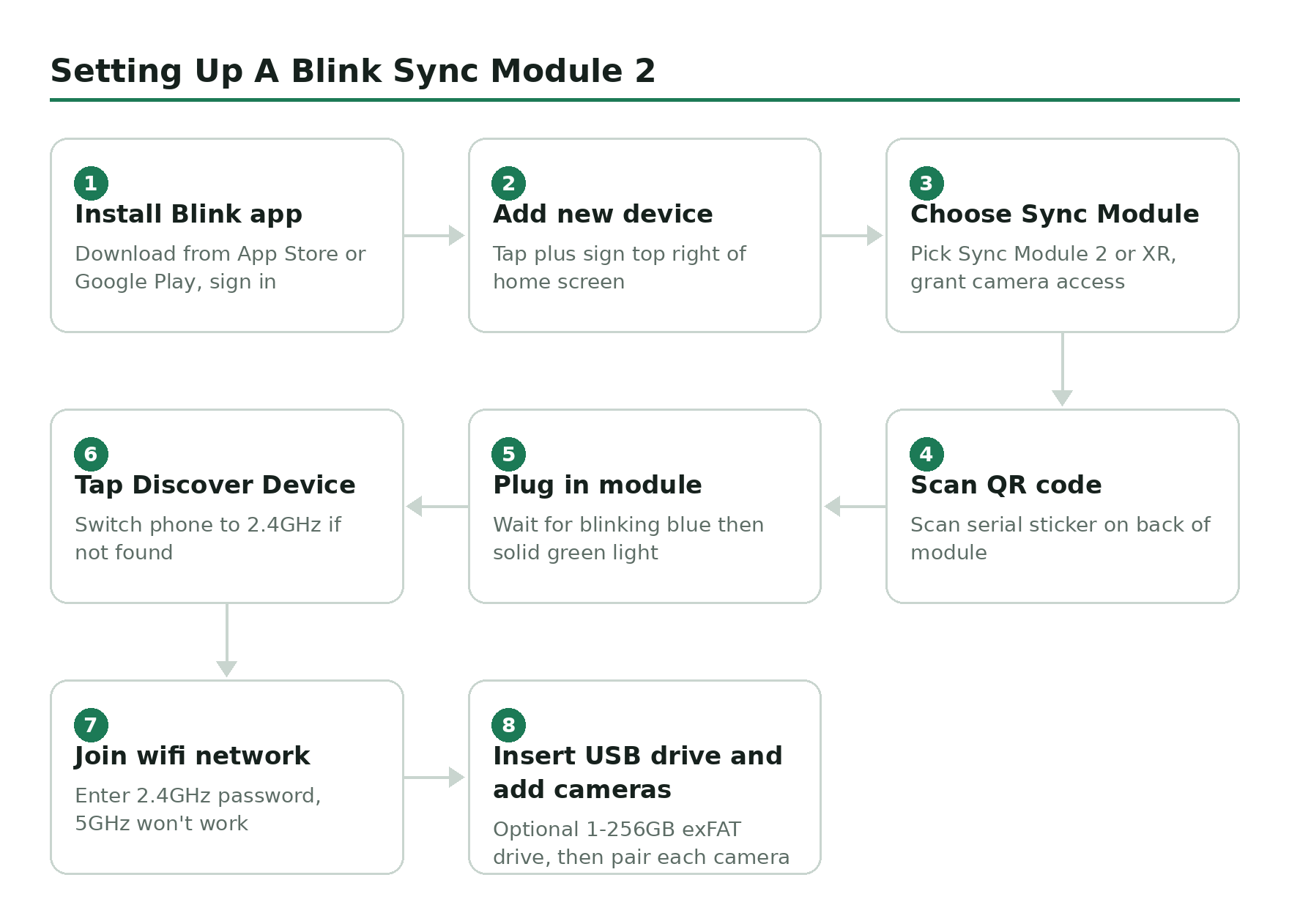
Plug the module in near your router, install the Blink app, scan the QR code on the back. The whole thing takes about three minutes.
Total Time: 3 minutes
Install the Blink Home Monitor app
Download it from the Apple App Store or Google Play. Sign in or create a Blink account.
Add a new device
Tap the plus sign in the top right corner of the app’s home screen.
Choose Sync Module
Pick Sync Module 2 (or Sync Module XR) from the list. Grant camera access when prompted – you’ll need it for the QR scan.
Scan the QR code
The serial number QR sticker is on the back of the module. Hold your phone steady until it reads.
Plug in the module
Use the included power adapter and USB cable. Wait for a blinking blue light and a solid green light – that means it’s awake and ready to be claimed.
Tap Discover Device
The app finds the module on your network. If it doesn’t, your phone is probably on a different wifi band – switch to 2.4GHz and try again.
Join your wifi network
Enter your 2.4GHz network password. The module will not connect to 5GHz networks.
Insert a USB drive (optional)
If you want local storage, plug a 1-256GB exFAT-formatted USB stick into the side port. The app will offer to format it – say yes.
Add your cameras
Back at the home screen, tap the plus sign again and pair each camera one at a time. They’ll attach to the new module automatically.
Where to put the Sync Module 2
Stick it as close to your router as you can manage, ideally on the same shelf. The module’s wifi range from the router is the bottleneck for everything downstream – if it has a strong signal, your cameras have a strong signal. The camera-to-module range is roughly 100 feet through typical drywall, less through brick or concrete.
If you’ve got a sprawling property and cameras at the back fence, the right answer isn’t usually a wifi extender (those tend to cause more flakiness than they solve). It’s either a mesh wifi node at the far end of the house, or – if you only need it for two Outdoor 4 cameras – the Sync Module XR with its 900MHz extended-range mode.
How many Sync Modules do I need?
One module handles up to 10 cameras. So:
- 1-10 cameras: one module
- 11-20 cameras: two modules
- 21-30 cameras: three modules (at which point you should probably have hired a proper installer six cameras ago)
Modules can’t pool cameras across themselves – each one runs its own group. Moving a camera from one module to another means deleting it and re-pairing on the new one.
Sync Module light meanings
- Solid blue + solid green: connected to wifi and online. This is the normal state.
- Blinking blue + solid green: awake and waiting for setup. Run the app’s add-device flow.
- Solid blue only: reset complete, ready to be re-paired.
- Solid red: no internet. Check your router. The module reaches wifi but the wifi has no upstream connection. See our guide on the red light on Blink devices.
- Blinking green: trying and failing to connect to wifi. Wrong password is the usual cause. We’ve got a full blinking green walkthrough.
- No lights: no power. Try a different USB cable or outlet.
How to reset a Sync Module 2
Two options, in order of effort:
- Soft reset: unplug it, count to ten, plug it back in. Solves about half of all flaky-module problems.
- Factory reset: with the module powered on, push a paperclip into the small recessed button next to the USB port and hold for at least 5 seconds. You’ll see red flashing, then blue flashing, then solid green – that’s a fresh module ready to set up again.
A factory reset doesn’t delete your cameras from your Blink account – it just disconnects them from this specific module. You’ll re-pair them after the module is set up again.
Common problems and fixes
Module keeps going offline
Usually a wifi signal issue. Move the module closer to the router. If that’s not possible, check that nothing big and metal (refrigerator, microwave, a TV mounted on a brick wall) sits between them. Worst case, the wifi itself is dropping – reboot the router, then the module. We’ve got a deeper dive in our Sync Module offline troubleshooting guide.
Camera won’t connect to the module
Reset the camera (pull and reinsert batteries on battery models). Move it closer to the module during pairing – you can relocate it after. If a specific camera refuses to pair after multiple resets, it’s almost always low battery, even if the app says otherwise. New AA lithiums fix it.
“Already registered to a different account”
The module was previously paired (common with secondhand units). Either the original owner needs to remove it from their account, or you’ll need to contact Blink support with proof of purchase. Full process in our already-registered fix guide.
USB drive shows “Bad” or won’t record
Pull the drive, format it as exFAT on your computer, plug it back in, then trigger the format option in the Blink app one more time. If it still fails, the drive is dying – try a different one. Cheap no-name flash drives die in months under constant write loads. Pay for a brand-name stick.
Weak signal between camera and module
Check the camera’s “WiFi” and “Sync Module” signal bars in the app (Camera Settings > Device Info). Anything below 2 bars is unreliable. Move the camera closer to the module, the module closer to the router, or both.
FAQ
Do I need a Blink subscription if I have a Sync Module 2?
No. With a USB drive plugged into the Sync Module 2, your motion clips save locally and you skip the subscription entirely. You’ll lose person and vehicle detection, extended live-view, and cloud access from outside the home network – but the cameras still record and you still get motion notifications.
How many cameras can one Sync Module 2 handle?
Up to 10 cameras per module. Add a second module if you need 11-20, a third for 21-30. The modules don’t pool cameras – each runs its own group of up to 10.
What’s the biggest USB drive I can use with Sync Module 2?
256GB. Drives larger than that won’t be recognized. There’s no reliable workaround using partitions. Buy a 256GB drive and stop optimizing.
Does Blink Mini 2K+ need a Sync Module?
No. The Mini and Mini 2K+ are wired cameras that connect directly to wifi. A Sync Module is only required if you want to record clips to local storage instead of paying for a subscription.
What’s the range of the Sync Module 2?
About 100 feet of camera-to-module range over standard 2.4GHz wifi. The Sync Module XR can reach 250-400 feet using a proprietary 900MHz radio, but only with up to two Outdoor 4 cameras, and only in the US and Canada.
Can I move a camera to a different Sync Module?
Yes – delete the camera from its current module in the Blink app, then add it to the new one. The camera itself doesn’t reset; you’re just re-pairing it.
Will the Sync Module 2 work on 5GHz wifi?
No. Like most Blink hardware, the Sync Module 2 is 2.4GHz only. If your phone is on 5GHz during setup, the discovery step will fail – switch your phone to the 2.4GHz network temporarily.
Should I buy the Sync Module XR instead?
Only if you specifically need extended range for up to two Outdoor 4 cameras at a distance. For everyone else, the Sync Module 2 does the same job for less money.
Bottom line
For most people building a Blink setup in 2026, the answer is the same as it was in 2021: buy a Sync Module 2, stick a 256GB USB drive in it, skip the subscription, done. The Sync Module XR exists for a narrow use case – two Outdoor 4 cameras on a property too big for normal wifi – and the original gen 1 module is a museum piece. Get the 2.