

This post contains affiliate links. If you buy through them, DumbSwitches may earn a commission at no extra cost to you. See our full disclosure.
Philips Hue “pairing mode” isn’t one thing – it’s at least three, depending on whether you’re adding the Bridge to your network, adding bulbs to the Bridge, or running a Bluetooth-only setup with no Bridge at all. The current Hue app (version 5.x, the one with the QR code scanner) handles all three through the same flow, but the on-device steps differ. Here’s what each one actually involves in 2026.
The quick decoder
- Pairing the Hue Bridge to your network – plug it in, open the Hue app, press the round button on the Bridge within 30 seconds when prompted.
- Pairing a bulb to the Bridge – power the bulb on, scan the QR code on the bulb’s box (or under the bulb itself) inside the Hue app, or use the six-digit serial number if the QR code is gone.
- Pairing a bulb directly to your phone (no Bridge) – turn on Bluetooth, open the Hue app, scan the QR code. Works only with Hue Bluetooth-capable bulbs, and only for one room at a time.
- Bulb won’t pair? Toggle the power off and on five times in quick succession. That’s the universal Hue reset.
- Hue Sync Box, Hue Secure cameras, and Hue Tap Dial all have their own pairing flows inside the same app.
What’s changed since 2023
A few things older Hue guides still get wrong:
- The separate “Hue Bluetooth” app is dead. Signify pulled it from the App Store and Google Play in December 2023 and folded its functionality into the main Hue app starting with version 4.13. If a guide tells you to download “the Bluetooth Hue app,” that guide hasn’t been touched in three years.
- The round Hue Bridge v1 is gone. Discontinued in 2020, cloud service shut down April 2025. If you’ve still got one, it works locally but can’t be controlled remotely, can’t get firmware updates, and can’t talk to Alexa, Google, or HomeKit anymore. The square Hue Bridge v2 is the standard, and the Hue Bridge Pro (launched September 2025) is the new high-capacity option.
- Pairing is QR-code-first now. Every Hue product sold since roughly 2022 has a QR code on the bulb itself and on the box. The app’s “Add device” flow opens the camera and expects to see one. Typing in serial numbers still works, but it’s the fallback path.
- Matter changed the rules. Hue Bridge firmware since 2024 can expose paired bulbs to Matter, which means the Bridge is now the cleanest way to get Hue lights into Apple Home, Google Home, and SmartThings without per-platform integrations.
Pairing the Hue Bridge itself
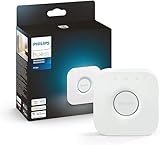
The Bridge is the small white square (or, if you’ve sprung for the Pro, the larger flat puck) that plugs into your router. Before you can add any bulbs through it, the Bridge has to be paired with your Hue account.
If the third light on the Bridge (the network/Wi-Fi indicator) stays off after a few minutes, the Bridge isn’t seeing your router. Check the Ethernet cable, then power-cycle the Bridge by unplugging it for 10 seconds. The Bridge Pro can also connect over Wi-Fi if your router is across the house from your modem, but the standard v2 needs a wired connection.
Pairing a Hue bulb to the Bridge
Once the Bridge is online, adding bulbs is the easiest part of the whole process. The current Hue app handles it through a single “Add device” flow that prefers the QR code on the bulb’s box. If the box is long gone, every Hue bulb also has a small printed serial number on its base.
The bulb needs to be within about 30 feet of the Bridge for the initial pairing. Zigbee will mesh out from there once you’ve got a few bulbs in the network, but the first one has to actually find the Bridge directly. If you’re trying to add a bulb at the far end of the house and it refuses, screw it into a fixture near the Bridge first, pair it there, then move it.
If you’re starting from scratch, the Hue White and Color Ambiance starter kit bundles the Bridge with four bulbs and is the cheapest way to get the full Bridge-based system.
Pairing a Bluetooth-only Hue bulb (no Bridge)
Most Hue bulbs sold since 2019 are Bluetooth-capable, which means you can run them straight from your phone with no Bridge in the picture. The trade-off: Bluetooth tops out at around ten bulbs per house, the range is limited to whatever room your phone is in, and you lose remote control, automations, the Hue widget, voice assistants, and Matter exposure. Bluetooth-only is fine for a single lamp in a studio apartment. It is not how anyone with more than one room should run Hue.
If you outgrow Bluetooth-only, you can add a Bridge later and the same bulbs will move over. The bulbs themselves don’t change; you just re-pair them through the Bridge flow above. Bulbs paired to a Bridge can’t simultaneously be controlled over Bluetooth, which trips up a lot of people.
When a bulb refuses to pair
Most pairing failures fall into one of four buckets:
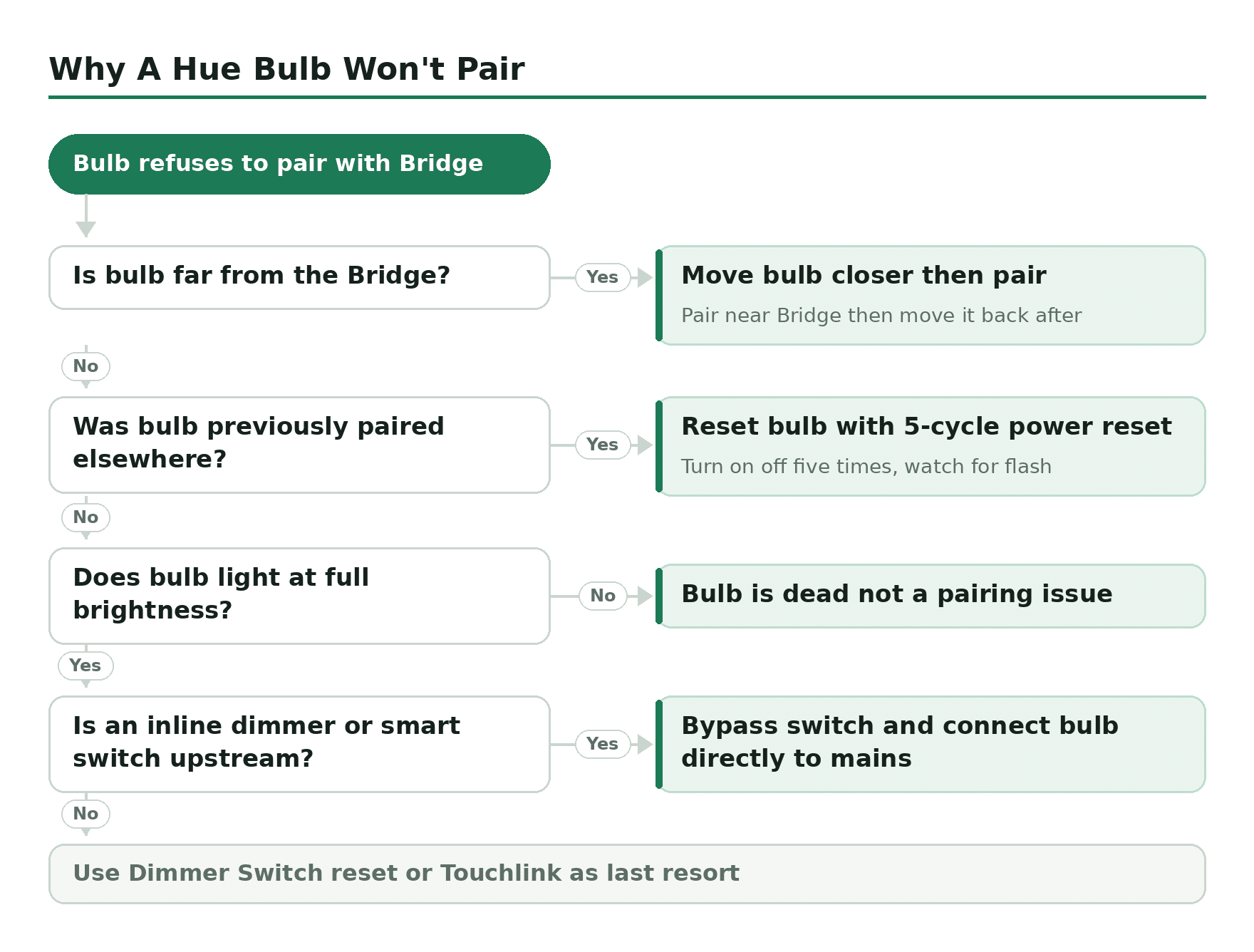
- The bulb is too far from the Bridge – move it closer, pair, then put it back. This fixes maybe a third of “stuck” bulbs.
- The bulb was previously paired to another Bridge or hub – common with used or hand-me-down bulbs. The bulb thinks it’s already on someone else’s network and won’t advertise itself. Reset it (see below).
- The bulb isn’t fully powered – sounds obvious, but a dimmer or smart switch upstream of the bulb can keep it from getting a clean voltage. Bypass any inline switches and connect the bulb directly to the mains.
- The bulb is dead – rare, but Hue bulbs do fail. If it doesn’t even light up at full brightness when you first power it, it’s not a pairing problem.
The 5-cycle power reset
The fastest way to factory-reset almost any Hue bulb is the wall switch. No app, no remote, no tools.
Turn the bulb on at the wall switch. Wait two seconds.
Turn it off. Wait two seconds.
Repeat the on-off cycle five times total. On the fifth power-on, the bulb should flash or pulse briefly, then return to steady light.
That flash is the reset confirmation. The bulb is now back to factory state and ready to pair to a new Bridge.
This works on every E26/E27 and GU10 Hue bulb made in the last decade. Lightstrips, Iris lamps, Go portables, and outdoor fixtures use the same method, just with their own power source rather than a wall switch.
Resetting with a Hue Dimmer Switch (more reliable)
If you’ve got a Hue Dimmer Switch v2 handy, it has a built-in reset function that talks to the bulb directly over Zigbee. This works even when the 5-cycle method doesn’t, which is common with bulbs that were paired to a non-Hue hub (SmartThings, Home Assistant, deCONZ) and didn’t get unpaired cleanly.
- Power-cycle the bulb you want to reset, then power it back on. You’ve got a 30-minute window after power-on to use the reset.
- Hold the Dimmer Switch within about 10 cm (4 inches) of the bulb.
- Press and hold the top “On” button and bottom “Off” button at the same time, for at least 10 seconds.
- The bulb flashes when the reset takes effect. Release the buttons.
The Hue Tap Dial Switch has an equivalent function (hold the Setup button on the back for 10 seconds near the bulb). Either one will rescue a bulb that the 5-cycle reset won’t budge.
Pairing Hue with Alexa, Google, and Apple Home
This is the part most older guides bury under fifty steps. The reality in 2026 is much shorter: get your bulbs onto the Hue Bridge first, then add the Bridge – not the individual bulbs – to whatever ecosystem you use. Every bulb on the Bridge inherits the integration.
Alexa
- Open the Alexa app, tap Devices, tap the plus icon, tap Add Device.
- Choose Light, then Philips Hue.
- Tap “Discover Devices.” Alexa walks you through enabling the Hue skill, signing into your Hue account, and pressing the round button on the Bridge.
- Once linked, every bulb on the Bridge shows up in Alexa. Group them or rename them in the Alexa app.
Google Home
- Open the Google Home app, tap Devices, tap Add, tap “Works with Google.”
- Search Philips Hue, sign in to your Hue account, and authorize the link.
- Press the round button on the Hue Bridge when Google prompts. All your bulbs and rooms sync over automatically.
Apple Home (HomeKit)
HomeKit pairing is built into the Hue Bridge itself – no skill, no account linking. Open the Home app, tap the plus icon, tap “Add Accessory,” then either scan the HomeKit code on the bottom of the Bridge or hold your iPhone near the Bridge for proximity pairing. For the full breakdown of what works and what doesn’t, see our Hue + HomeKit guide.
SmartThings, Matter, and everything else
As of 2024, the Hue Bridge can expose its bulbs to Matter, which means SmartThings, Home Assistant, and any other Matter controller can pick them up without a vendor-specific integration. In the Hue app: Settings, then Matter, generate a pairing code, paste it into your Matter controller. Done.
If you’d rather use SmartThings’ older direct integration, it still works: in the SmartThings app, tap Add Device, search Philips Hue, choose “Philips Hue with Hue Bridge,” sign in, and press the round button on the Bridge when prompted.
The Hue Sync Box pairs differently
The Sync Box (HDMI box that syncs Hue lights to your TV) is paired through the dedicated Hue Sync app, not the main Hue app, and it pairs to your Bridge rather than to bulbs directly. The flow: install the Hue Sync app, sign in with the same Hue account, tap “Add Sync Box,” follow the prompts. The Sync Box itself has no QR code – it’s identified by serial number and a button on the unit.
Worth noting: as of 2025, Signify has been slowly migrating Sync Box features into the main Hue app, but the separate Hue Sync app is still required for the entertainment area setup itself.
Common pairing failures and what they mean
- “No new lights found” after scanning the QR code – bulb is out of range of the Bridge, or it’s already paired to something else. Move it closer or reset it.
- App finds the Bridge but pairing fails after you press the button – usually a router firewall blocking the Bridge’s outbound connection on port 443. Try pairing while connected to the same Wi-Fi network the Bridge is on, not a guest network.
- Bulb flashes constantly and won’t stop – the bulb is in the middle of a firmware update or a failed reset. Leave it powered on for at least 10 minutes before touching it.
- Dimmer Switch won’t pair – press and hold the Setup button on the back of the Dimmer Switch for 10 seconds to reset it, then add it as a new accessory in the Hue app.
- “Bulb unreachable” after it was working – typically a Zigbee mesh issue. Power-cycle the closest Bridge-connected bulb to that one; the mesh will rebuild itself.
Touchlink: the last-resort pairing method
Touchlink is a Zigbee Light Link feature that lets a controller (like a Hue Dimmer Switch held close to a bulb) talk directly to a bulb regardless of which network it’s on. The main Hue app doesn’t expose Touchlink as a user-facing feature, but third-party Zigbee tools (Home Assistant’s ZHA, Zigbee2MQTT, deCONZ) do.
If you’ve got a bulb that won’t reset by power cycling and won’t accept a Dimmer Switch reset, Touchlink through Zigbee2MQTT is the last reliable option. It requires a separate Zigbee coordinator (a USB stick like the Sonoff ZBDongle-E) and isn’t worth the effort for one bulb, but it does work when nothing else does.
Related Hue guides
- Does Philips Hue work with Apple HomeKit? – what’s natively supported and what still needs HomeBridge.
- Do all Philips Hue lights change color? – White vs White Ambiance vs White and Color, in plain English.
- How to sync Philips Hue with your TV without a Sync Box – the cheaper Hue Sync route.
- Philips Hue Go battery life – the portable Hue lamp and how long it actually lasts.
- Best Apple HomeKit dimmable light bulbs – if you’re not sure Hue is the right call.