
This post contains affiliate links. If you buy through them, DumbSwitches may earn a commission at no extra cost to you. See our full disclosure.
The Philips Hue Go runs for up to 3 hours on battery at full brightness. Drop the brightness or switch to a warmer scene and that figure stretches considerably – down to as little as dim candlelight mode, which can last 18 to 24 hours on a single charge. Which version you own also matters a lot: Philips has shipped three distinct iterations since 2015, each with meaningfully different battery specs.
What Affects Battery Life
Three things eat into your Hue Go’s battery faster than anything else:
- Brightness. The Hue Go automatically drops to around 40% brightness when you unplug it – roughly 120 lumens instead of the 300+ it pumps out at full power. You can push it back up in the app, but your runtime will shrink fast. At maximum brightness with a cool white scene, expect 2.5-3 hours. At lower settings, expect significantly more.
- Color temperature. Cool whites and full-spectrum colors pull more power than warm whites or dim amber tones. Relax mode (a warm, low-intensity white) can push battery life to around 9 hours on the Gen 1, or much longer on the Gen 2. High-saturation colors – reds, blues, greens at full blast – drain faster than neutral whites at the same brightness.
- Ambient temperature. Lithium-ion cells lose capacity in cold environments. If you’re using your Hue Go outside in winter, don’t be surprised if battery life comes in below the rated figures.
First Gen vs Second Gen Battery Specs
Philips has released three Hue Go hardware generations. Here’s how the battery specs break down:
| Model | Released | Max brightness runtime | Low/night light runtime |
|---|---|---|---|
| Hue Go Gen 1 | 2015 | ~3 hours | Up to 9 hours (Relax mode) |
| Hue Go Gen 2 | 2019 | ~2.5 hours (bright white) | Up to 24 hours (night light) |
| Hue Go Portable Table Lamp | 2022 | Not officially specified | Up to 48 hours |
The Gen 2 (2019) doubled the battery capacity of the original – Philips increased the battery size significantly while also adding Bluetooth control. The 2022 Portable Table Lamp pushed things further still, with the 48-hour figure representing use in low-light modes.
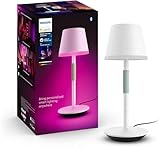
If you have the Gen 1, the round puck design with no Bluetooth is your tell. You can pick up the current Portable Table Lamp version on Amazon (White: B0B9T2LW6R | Black: B0BG99KDKP), or the Gen 2 round portable (B00UVHAC1O) is still available if you prefer that form factor.
Tips to Extend Battery Life
- Use the preset scenes. Relax, Read, and Nightlight are specifically tuned for lower power draw. The difference between Energize (bright, cool white) and Nightlight (dim, warm amber) is several hours of runtime.
- Don’t fight the auto-dimming. When you unplug the Go, it automatically drops to 40% brightness. That’s intentional. If you keep overriding it to full brightness, you’re cutting your battery life in half.
- Check battery level in the Hue app. The app shows a battery icon for the Go. If it’s flashing red, you’re nearly empty. Don’t let it drain to zero regularly – that shortens overall battery lifespan over time.
- Keep it cool. If you’re using it outdoors on a hot day, the heat will reduce capacity slightly. Shade it when possible if battery life matters.
- Charge before trips, not mid-use. Charging takes around 90 minutes from empty. Better to start with a full battery than rely on a top-up during use.
Charging and Using Simultaneously
Yes – you can run the Hue Go while it’s plugged in. This is actually the recommended way to use it if you’re keeping it in one place for an extended period. Plugged in, the lamp behaves like a standard Hue light: full brightness, full Hue Bridge integration, and it stays permanently available to the app, voice assistants, and automations.
When unplugged, the Go switches to battery mode and loses some functionality – it still works with Bluetooth, but if you rely on Hue Bridge for automations and scenes, those will only work while it’s connected to your network via the bridge. Plugging it back in restores everything.
Charging takes approximately 90 minutes from flat to full. The battery indicator in the Hue app shows charging status – when the icon is flashing red, the battery is either critically low or actively charging.
Battery Replacement
The Hue Go uses two built-in rechargeable lithium-ion 14500 cells (the same physical size as AA, but rechargeable at 3.7V). They’re not user-serviceable in the normal sense – Philips doesn’t sell replacement packs or officially support DIY swaps – but the batteries are physically accessible if the cells degrade significantly over time.
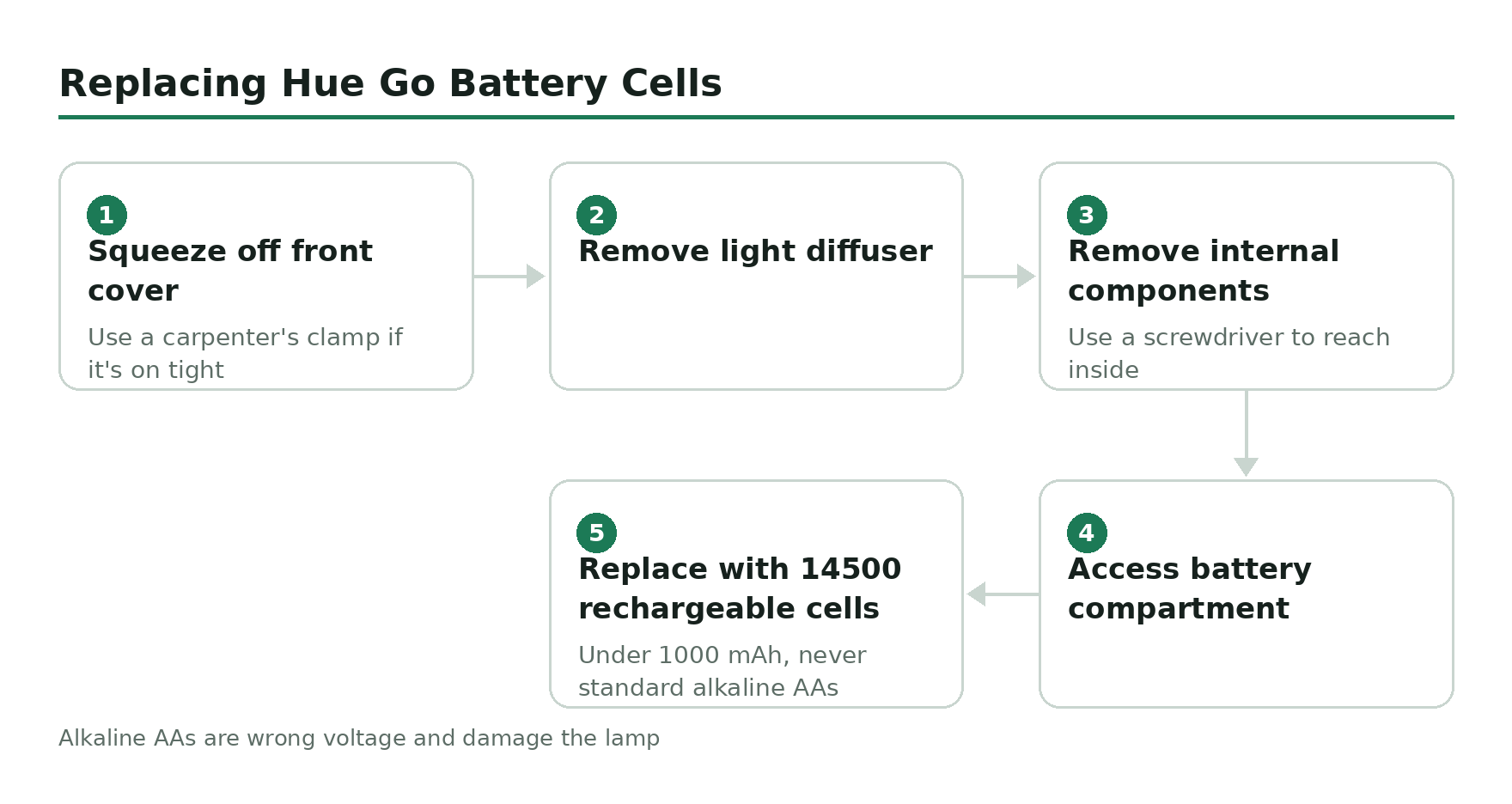
To get to them, you squeeze the front cover until it pops off (a carpenter’s clamp works better than fingers if it’s on tight), then remove the light diffuser and internal components with a screwdriver until you reach the battery compartment. Replace with AA-sized rechargeable 14500 cells under 1000 mAh capacity – avoid standard alkaline AAs, which are the wrong voltage and will damage the lamp.
For most people, this isn’t necessary for years. Lithium-ion batteries at this scale typically retain usable capacity for 300-500 charge cycles before degrading noticeably. If you charge once a week, that’s 5-10 years of useful life from the original cells.
Here’s a video walkthrough of the process if you need it:
Related Guides
If you’re deciding whether the 2022 redesign is worth upgrading to, our Philips Hue Go 2 review covers everything that changed – form factor, battery, brightness, and whether the new table lamp design is actually better for everyday use.