

This post contains affiliate links. If you buy through them, DumbSwitches may earn a commission at no extra cost to you. See our full disclosure.
An armed Blink system records motion and pings your phone. A disarmed one ignores everything. That’s the whole concept – and the catch is that arming is a system-level switch, not a per-camera one. If you’ve got three cameras on one Sync Module, they all flip together.
Last updated: May 2026. Verified against Blink’s official support docs (arming, scheduled arming, motion detection, and the Alexa Blink skill).
The quick decoder
- Armed – cameras with motion detection enabled will detect motion, push you a notification, and record a clip (if you have storage set up). Live View still works.
- Disarmed – no motion detection, no notifications, no motion clips. You can still pull up Live View on demand, and you can still get a doorbell press alert from a Blink doorbell.
- System-level only – arming applies to every camera on the same Sync Module. You can’t arm just one. To get per-camera control, you either toggle motion detection on each device, or split cameras across multiple Sync Modules.
- Storage required for recording – clips only save if you have a Blink Subscription Plan or local storage on the Sync Module 2 / Sync Module XR via a USB drive.
What “armed” actually does
When you tap Armed at the bottom of the Blink app’s home screen, every camera on that system goes into watch mode. Each camera’s PIR sensor wakes up, scans its motion zones, and triggers a clip plus a phone notification when something crosses the zone.
Two things have to be true for a clip to actually save:
- The system has to be armed.
- Motion detection has to be enabled on that specific camera (Device Settings – Motion Settings).
If motion detection is off on a camera, arming the system does nothing for that camera. It just sits there. This is Blink’s official position: “only cameras with motion detection enabled will detect motion. If motion detection is disabled for a camera, it will remain off even when the system is armed.”
That distinction is the trick to arming one camera while leaving the others passive – more on that below.
What “disarmed” actually does
Tap Disarmed at the bottom of the home screen and every camera on that system stops watching. No motion detection, no notifications, no recording. The cameras are still online and still connected – you just told them to ignore the world.
A few things keep working when disarmed:
- Live View – you can still tap any camera to stream it on demand.
- Manual clip recording – hit the record button during Live View and the camera saves the stream.
- Doorbell press alerts – on the Video Doorbell and Battery Doorbell 2K+, a press still notifies you even when the system is disarmed. The doorbell is a doorbell first and a motion camera second.
- Two-way audio – works any time the camera is online, armed or not.
How to arm or disarm in the Blink app
Three taps. The toggle has lived at the bottom of the home screen since the big app redesign, and it hasn’t moved.
Open the Blink app and go to the home screen of the system you want to control.
At the bottom of the screen, tap Armed to arm the system or Disarmed to disarm it.
Wait for the confirmation message. The button highlights to show the current state.
If you’ve got more than one system (i.e. more than one Sync Module), each one has its own arm/disarm state. Arming “Front of House” doesn’t touch “Garage.” You have to do them separately, or use a schedule, or use Alexa with both system names.
Arming or disarming with Alexa
If you’ve got an Echo (or any Alexa device), the Blink SmartHome skill handles voice control. Setup is a one-time pairing in the Alexa app, and then it just works.
In the Alexa app, enable the Blink SmartHome skill and link your Blink account.
Set an Alexa Voice Code (4-digit PIN). This is required to disarm by voice – it’s a security feature, not optional.
To arm: say “Alexa, arm [system name]” – swap [system name] for whatever you named your Blink system.
To disarm: say “Alexa, disarm [system name]” – Alexa will prompt for your voice code. Speak it as individual digits (“one, two, three, four”).
One quirk: you can build an Alexa Routine that arms Blink (handy for “Alexa, goodnight”), but you cannot disarm via a Routine. The voice code requirement blocks it. If that bothers you, blame Amazon’s lawyers, not the Blink team.
Scheduled arming and disarming
The cleanest way to run a Blink system is to never touch the arm button at all. Set a schedule once and let the app do it. Arm at 7am when you leave for work, disarm at 6pm when you get home, arm again at midnight, done.
Open the Blink app and tap the Settings icon at the bottom right of the home screen.
Tap Device and System Settings, then pick the system you want to schedule.
Confirm the system time zone is correct. Wrong time zone is the single most common reason schedules fire at the wrong hour.
Tap Scheduling to open the Weekly Schedule screen.
Tap the + button. Pick a time (in 15-minute increments), pick the days, leave the toggle on Arm. Save.
Tap + again. Set your disarm time, pick days, flip the toggle to Disarm. Save.
Manual taps still work over the top of a schedule. If you’re scheduled to arm at 8am and you tap Disarm at noon, the system stays disarmed until the next scheduled event fires. The schedule doesn’t reach back and re-arm you mid-day.
If you want a temporary break from the schedule (going on vacation, having work done on the house), there’s a “disabled” toggle right in the Scheduling screen. Flip it off and the schedule stops firing without you having to delete the entries.
Can you arm just one Blink camera?
Not directly. Arming is system-level. But there are two workarounds, and one of them is genuinely the right answer:
Workaround 1: toggle motion detection per camera
This is the clean way. Arm the whole system, then go into each camera’s Device Settings and turn Motion Detection off for the cameras you don’t want active. The system thinks it’s armed; the cameras with motion off just sit there.
Useful if, say, the backyard camera should always watch but the kitchen one shouldn’t trigger every time someone makes coffee at 2am.
Workaround 2: multiple Sync Modules
Each Sync Module is its own system with its own arm/disarm state and its own schedule. Split your cameras across two or three Sync Modules and you can arm and disarm them independently from the app.
This is overkill for two cameras. It makes sense if you’ve got six or seven and genuinely want separate schedules for indoors and outdoors, or for the main house and a garage that’s out of range of the primary Sync Module anyway.
Troubleshooting armed/disarmed weirdness
The system won’t arm
Almost always an offline camera. If even one camera on the system is offline, Blink refuses to arm the whole system. Open the app, find the camera with the no-signal icon, and either bring it back online (Wi-Fi, batteries, Sync Module reboot) or delete it from the system if you’re not using it anyway.
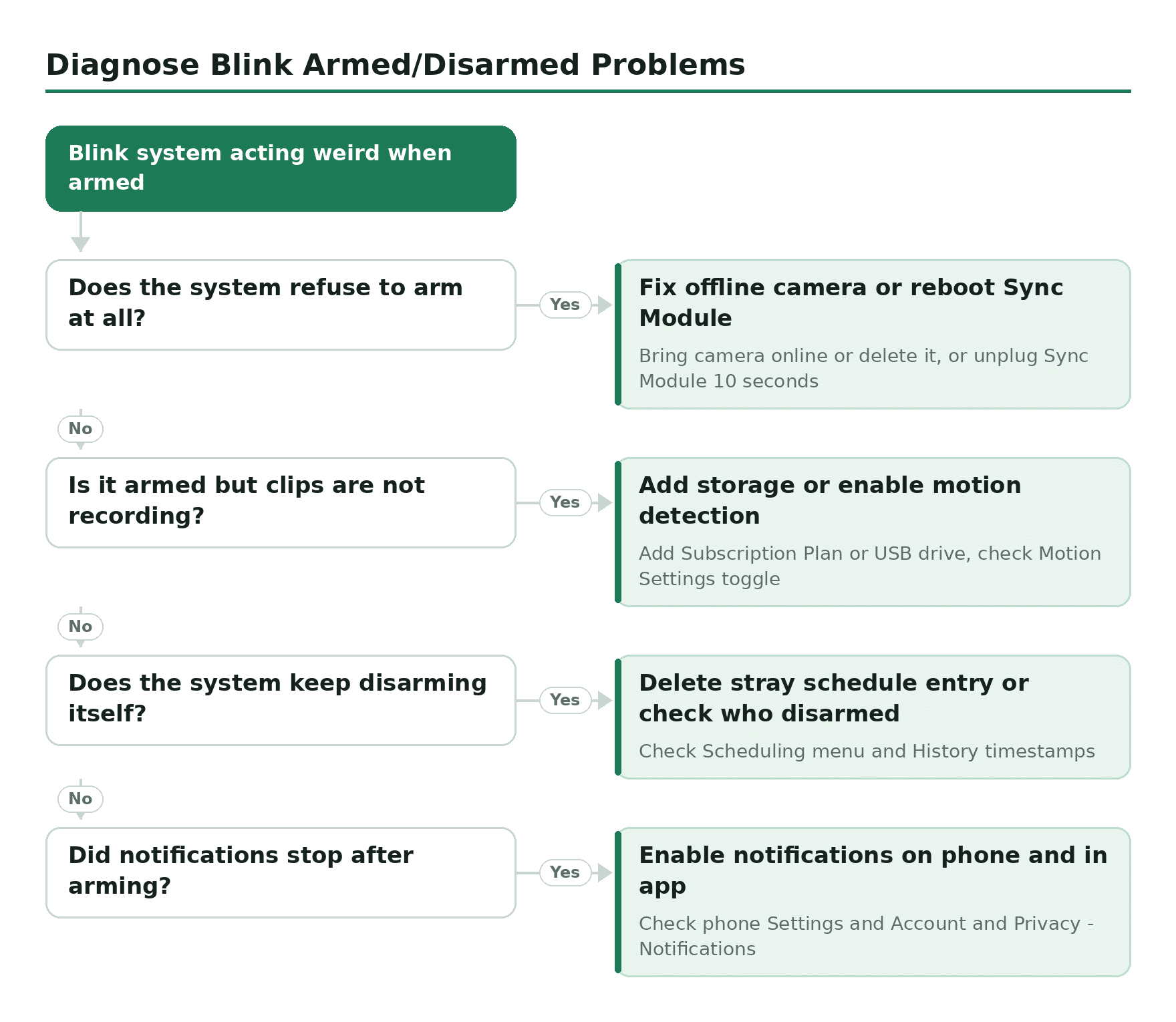
Second most common cause: the Sync Module itself is offline. Unplug it for 10 seconds and plug it back in. Wait for the solid blue plus solid green LED combo before trying again.
Armed but not recording
Two things to check, in this order:
- Do you have storage? No subscription and no USB drive in the Sync Module 2 / XR means motion will detect but clips won’t save. You’ll get notifications without any video attached. Fix: add a Blink Subscription Plan or plug a USB stick (1GB to 256GB, FAT32 or exFAT) into the Sync Module’s USB port.
- Is motion detection on for that camera? Device Settings – Motion Settings. If the toggle is off, the camera ignores motion even with the system armed.
The system keeps disarming itself
Check your schedule. The single most common cause is a leftover schedule entry that disarms at a time you forgot about, often from when you first set the app up and were just clicking around. Settings – Device and System Settings – your system – Scheduling. Delete anything you don’t recognize.
Second cause: someone else in the house has the Blink app on their phone and is hitting Disarm. The app doesn’t tell you who disarmed it, but History does show the timestamp. Compare that against when people walk in the door.
Notifications stopped after arming
Phone-side problem, not Blink. Open your phone’s Settings, find the Blink app, and check that notifications are allowed (and not just allowed but actually set to alerts, not silent). Then in the Blink app itself, Account and Privacy – Notifications – make sure Motion is enabled.
FAQ
Does Blink record when disarmed?
No automatic recording. The cameras don’t run motion detection and don’t save clips when the system is disarmed. You can still manually record from Live View if you want a clip on demand.
Can I arm just one Blink camera?
Not directly – arming is system-wide. The workaround is to arm the whole system and then disable motion detection on the cameras you don’t want active in Device Settings. For genuinely separate control, put cameras on different Sync Modules.
Will Live View work when the system is disarmed?
Yes. Live View, two-way audio, and manual record from Live View all work regardless of armed state. Disarming only stops automatic motion-triggered recording and alerts.
Do I need a Blink subscription for armed mode to work?
No, but you need either a subscription or local USB storage on a Sync Module 2 or Sync Module XR for clips to actually save. Without storage, an armed system will still detect motion and notify you – it just won’t store the video.
Can I arm Blink with Alexa?
Yes. Enable the Blink SmartHome skill in the Alexa app, then say “Alexa, arm [system name].” Disarming via Alexa requires a 4-digit voice code that you set up during Alexa pairing, and disarm cannot be done via Alexa Routines for security reasons.
Does a scheduled arm override a manual disarm?
Manual taps win until the next scheduled event. If you’re on a schedule to arm at 8am and you manually disarm at noon, the system stays disarmed until the next scheduled arm or disarm event fires.