

This post contains affiliate links. If you buy through them, DumbSwitches may earn a commission at no extra cost to you. See our full disclosure.
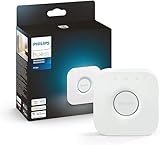
Yes – Philips Hue works with Apple HomeKit as long as you’ve got a second-generation Hue Bridge (the square one). The Bridge talks to Hue’s Zigbee bulbs and exposes them to the Home app, which gives you on/off, dimming, color, Adaptive Lighting, scenes, and Siri control. Bluetooth-only Hue bulbs with no Bridge won’t show up in Apple Home at all. See how Hue stacks up against Nanoleaf, Aqara, and other Matter options in our best smart bulbs comparison.
The quick version
- Hue Bridge v2 (square): full HomeKit support. Add it once, every paired bulb shows up in Apple Home automatically.
- Hue Bridge Pro (released late 2025): also HomeKit-compatible. If you migrate from v2 to Pro, Apple Home will lose the old Bridge and you’ll need to add the Pro fresh.
- Hue Bridge v1 (round): dead. Signify pulled cloud support in April 2020 and it never had Matter or modern HomeKit reliability. Not worth keeping.
- Bluetooth-only Hue bulbs (no Bridge): no HomeKit. They only work through the Hue Bluetooth app on the phone they were paired from.
- Matter: the Bridge has exposed Hue lights as Matter accessories since the 2024 firmware update, so Apple Home, Google Home, and Alexa all see the same devices.
- Hue Secure cameras and contact sensors: Apple Home support landed in late 2025 for the wired Secure cameras, the wired 2K doorbell, and the contact sensors. Battery-powered Secure cameras are still Hue-app only.
Why you need the Bridge
Hue bulbs run on Zigbee. Apple Home doesn’t speak Zigbee – it speaks Wi-Fi, Thread, and (since 2022) Matter. The Philips Hue Bridge v2 sits between the two: Zigbee on one side, Ethernet to your router on the other, and a HomeKit/Matter accessory profile that the Home app can pair with.
Without it you can technically use Hue bulbs over Bluetooth in the standalone Hue Bluetooth app, but you can’t get them into Apple Home, you can’t control more than about 10 bulbs at once, and you can’t reach them from outside the room. The Bridge is the whole point.
Pairing the Hue Bridge to Apple Home
This takes about three minutes if your Bridge is already set up in the Hue app and online. If it isn’t, run through the Hue app setup first, then come back here.
Flip the Hue Bridge over and find the HomeKit setup code on the bottom sticker.
Open the Home app on iPhone or iPad. Tap the plus icon, then Add Accessory.
Point the camera at the QR code on the Bridge sticker. The Home app should find it within a few seconds.
If the camera scan misses, tap More Options, pick the Hue Bridge from the list, and type the eight-digit code by hand.
Assign the Bridge to a room (this part doesn’t matter much – rooms are reassigned per bulb anyway).
Wait. The Home app pulls every paired bulb, switch, and sensor from the Bridge automatically. On a busy system this can take a minute.
Rename and re-room your bulbs in the Home app so Siri commands make sense.
If you bought a Hue White and Color Ambiance starter kit with the Bridge included, the QR code is on the Bridge itself, not the box. Don’t bin the sticker before you scan it.
What works in Apple Home (and what doesn’t)
The Home app gives you the core stuff. The Hue app gives you everything else. Knowing which is which saves a lot of bouncing back and forth.
Works in the Home app
- On/off and brightness for every paired bulb.
- Full color and color-temperature control on White and Color Ambiance bulbs.
- Adaptive Lighting – the warm-in-the-morning, cool-at-noon, candle-y-at-night automatic shift that Apple introduced in iOS 14.
- HomeKit scenes (different from Hue scenes – more on this below).
- Siri commands, including the regional-grammar weird ones like “Hey Siri, set the bedroom to 30 percent.”
- Automations – run a Hue scene when you arrive home, when a door sensor trips, at sunset.
- Hue Motion Sensors, Hue Dimmer Switches, Hue Smart Buttons, and the Tap Dial Switch as triggers.
- The wired Hue Secure cameras and the wired Hue Secure 2K doorbell, including live view, since the late-2025 update.
Does not cross over
- Hue’s own scenes: the curated gradients from the Hue app (Savanna sunset, Tropical twilight, etc.) live in the Bridge as Hue-app scenes and don’t appear in Apple Home. You have to rebuild them as HomeKit scenes manually, or trigger the Hue scene from a Hue Dimmer Switch and let Apple Home read the bulb state afterwards.
- Hue Sync and the Entertainment area: the music/TV-syncing party trick. Needs the Hue Sync app on a Mac or PC, or the Sync Box accessory. Apple Home has no idea this exists.
- Hue Sync Box TV mode: the HDMI passthrough box that syncs lights to whatever’s on your TV. Pure Hue ecosystem, no Apple Home control.
- Hue Labs formulas: Signify’s experimental automation features. Hue app only.
- Battery-powered Hue Secure cameras: still locked to the Hue app as of mid-2026.
Bridge v2 vs Bridge Pro – which one do you need?
Signify launched the Hue Bridge Pro in late 2025 alongside the Hue Secure expansion. It’s the first new Bridge hardware in roughly a decade. Both versions work with HomeKit. The differences come down to capacity and speed.
- Bridge v2: 50 lights, 12 accessories, around 250 scenes. Fine for a normal house.
- Bridge Pro: 150+ lights, 50+ accessories, 500+ scenes. Quad-core processor. Wi-Fi as well as Ethernet, which doesn’t actually help much – run it wired anyway.
If you have fewer than 30 bulbs and you’re not running motion-sensor automations all day, the standard Bridge v2 is the right answer and it’s still being sold. If you’ve covered a 4,000-square-foot house in Hue and your scenes take a noticeable second or two to fire, the Bridge Pro is the upgrade. Be warned: Apple Home loses the old Bridge during migration, so you’ll re-pair the Pro and re-add bulbs to your rooms manually.
Matter changes nothing important, but it’s there
Both Bridges expose Hue bulbs to Matter, which means Apple Home, Google Home, and Amazon Alexa can all control the same lights without picking a side. In practice, the native HomeKit integration through the Bridge is older, more polished, and supports things Matter doesn’t (Adaptive Lighting, for example). Keep HomeKit pairing on, ignore Matter unless you actually need cross-platform control, and you won’t miss anything.
Siri commands worth memorizing
Siri runs on Apple Home device and room names. Whatever you call the bulb in the Home app is what you say to Siri. Some that work cleanly:
- “Hey Siri, turn on the bedroom.”
- “Hey Siri, set the kitchen to 40 percent.”
- “Hey Siri, make the living room warm white.”
- “Hey Siri, set the office to blue.”
- “Hey Siri, run Movie Night.” (where Movie Night is a HomeKit scene you’ve built.)
- “Hey Siri, turn off everything.” (kills every HomeKit accessory in the home, not just lights.)
Troubleshooting Hue and HomeKit
Most Hue-in-HomeKit problems trace back to the Bridge, not the bulbs. Work the Bridge first.
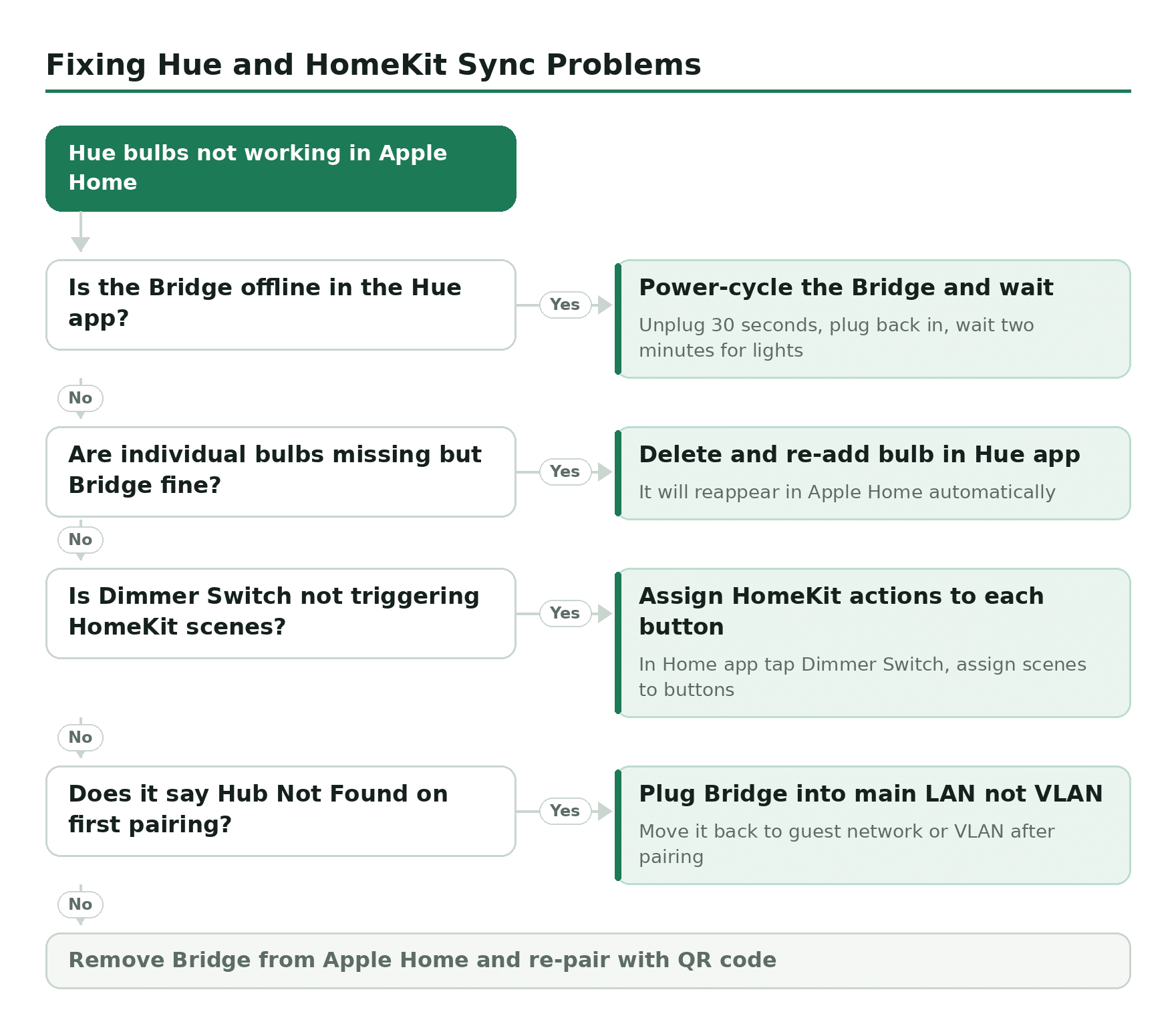
Confirm the Hue Bridge is online in the Hue app. If the Hue app can’t see it, Apple Home definitely can’t.
Power-cycle the Bridge – unplug, wait 30 seconds, plug back in. Wait two minutes for the three lights to come back solid.
Reboot your Apple Home hub (HomePod, HomePod mini, or Apple TV). Settings, Home, then sign out and back in if needed.
In the Home app, tap the Bridge tile and check Status & Notifications. If it says No Response, your network is the problem, not Hue.
If individual bulbs are missing but the Bridge is fine, open the Hue app, delete the rogue bulb, and re-add it – it will reappear in Apple Home automatically.
As a last resort, remove the Bridge from Apple Home entirely and re-pair it using the QR code on the bottom. You’ll keep all your Hue app scenes; you’ll rebuild your HomeKit scenes.
Hue Dimmer Switch not triggering HomeKit scenes
The Hue Dimmer Switch v2 is a HomeKit accessory in its own right. If your buttons aren’t firing HomeKit automations, the switch is probably still wired to its default Hue-app behavior. Open the Home app, find the Dimmer Switch, tap each button, and assign HomeKit actions to them directly. Buttons can run HomeKit scenes or trigger any Home automation.
“Hub Not Found” on first pairing
The Bridge needs to be on the same Wi-Fi network as your iPhone for the initial HomeKit pair. If you’ve got a guest network or a separate IoT VLAN, plug the Bridge into the main LAN for setup, then move it back once it’s paired. Apple’s HomeKit pairing is mDNS-based and doesn’t cross VLANs cleanly.
Bulbs work in Hue app but missing from Apple Home
Usually a Bridge sync issue. Open the Hue app, go to Settings, Hue Bridge, Apple HomeKit. There should be a “Pair” or “Sync” button – tap it. If the bulb still doesn’t show, see how to put a Hue bulb in pairing mode and re-add it from scratch.
Hue with HomeKit FAQ
Can you use Philips Hue with HomeKit without a Bridge?
No. Bluetooth-only Hue bulbs cannot join Apple Home. The Bridge is what translates Zigbee to HomeKit/Matter, and without it the bulbs are invisible to Apple’s smart home stack. The cheapest path in is a starter kit that includes the Bridge.
Where is the HomeKit setup code on the Hue Bridge?
On a sticker on the bottom of the Bridge. It’s an eight-digit code plus a QR code. If you’ve already thrown the sticker out, you can also find the code under Settings, Hue Bridge, Apple HomeKit in the Hue app.
Should I use Matter or HomeKit for Hue?
Stick with native HomeKit through the Bridge. The HomeKit integration is older, more reliable, and supports Adaptive Lighting. Matter is useful only if you also need Google Home or Alexa control of the same lights.
Do Hue Secure cameras work with HomeKit?
The wired Hue Secure cameras and the wired Hue Secure 2K doorbell support Apple Home, with live view, as of the late-2025 update. The battery-powered Hue Secure cameras are still Hue-app only and there’s no public timeline for HomeKit support on them.
Does the round Hue Bridge v1 still work with HomeKit?
No – and it hasn’t for years. Signify ended cloud support for the Bridge v1 in April 2020. It also can’t do Matter and it never got modern HomeKit features. Upgrade to a Bridge v2 or Bridge Pro.
Related guides
- Best HomeKit-compatible dimmable bulbs – Hue is on the list, but it isn’t the only option.
- How to put a Philips Hue bulb in pairing mode – useful when a single bulb refuses to join the Bridge.
- Does Eufy work with HomeKit? – companion piece for the Eufy camera lineup.
- Does Govee work with HomeKit? – Hue’s main mid-market RGB rival, also covered.