

This post contains affiliate links. If you buy through them, DumbSwitches may earn a commission at no extra cost to you. See our full disclosure.
Yes – but only on the Kasa products that ship with Matter. TP-Link spent years refusing to pay Apple’s MFi tax, which is why Kasa was Alexa-and-Google country for most of its life. Matter ended that argument. The Matter-certified Kasa plugs, switches, and dimmers pair straight into Apple Home over Wi-Fi using a QR code. Anything older than the Matter line still needs Homebridge (or a paid bridge) to show up on an iPhone.
The short version
- Native HomeKit: none. Kasa never shipped a HomeKit-certified product – not one.
- Matter (works in Apple Home with no bridge): the Kasa Matter Smart Plug Mini (KP125M), the Matter Outdoor Smart Plug (EP40M), the Matter Light Switch (KS205), and the Matter Dimmer Switch (KS225). That’s it. Four products.
- No Matter bulbs. Kasa’s KL125 and KL135 colour bulbs are Wi-Fi only and there is no Matter version – if you want HomeKit-friendly bulbs from TP-Link, the Tapo L535E (Matter) is the path.
- Everything else (Kasa cameras, older plugs, the original KP115, the Smart Light Switch HS200, KL125/KL135 bulbs): Matter-incompatible at the hardware level. Homebridge only.
- You need: iOS 16.2 or later, a HomePod / HomePod mini / Apple TV 4K / iPad acting as your Apple home hub (Matter requires a controller), and 2.4 GHz Wi-Fi. Kasa’s Matter implementation is Wi-Fi-only – no Thread.
Why Kasa was a HomeKit dead zone for so long
For years the answer to “does Kasa work with HomeKit?” was a flat no. TP-Link’s Kasa line targeted the cheap end of the smart-home market, and the cheap end can’t really absorb Apple’s MFi licensing fees – the per-unit cost, the hardware co-processor, the certification dance. So Kasa shipped Alexa and Google Assistant support and called it a day. Apple users had two options: stare wistfully at the box, or run Homebridge.
Matter rewrote the rules in 2023. TP-Link can now ship one firmware that speaks to Apple Home, Google Home, Alexa, and SmartThings at the same time without paying Apple a cent. So they did – first with the Kasa Matter Smart Plug Mini (KP125M) in April 2023, then a pair of Matter wall switches in August 2023, then a Matter outdoor plug. The Tapo brand (also TP-Link) got the Matter treatment in parallel and now has a wider lineup – more on that below.
Which Kasa devices work with Apple Home over Matter
This list is current as of May 2026 and based on TP-Link’s official Matter product page. Matter support is hardware-gated, so the chip has to be there from the factory – no firmware update is going to bolt it onto a 2021 Kasa plug.
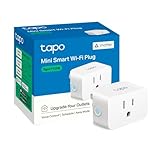
- Kasa Matter Smart Plug Mini (KP125M) – the first Kasa product to ship with Matter. Energy monitoring on board, though you can only see the kWh data in the Kasa app, not in Apple Home. (Matter doesn’t carry energy data yet.)
- Kasa Matter Outdoor Smart Plug (EP40M) – two weather-resistant sockets, designed for string lights and yard gear. Same Matter-over-Wi-Fi setup as the indoor plug.
- Kasa Matter Smart Light Switch (KS205) (also on Amazon) – single-pole, neutral wire required, no hub, no Sync Module, no Kasa cloud account. Pairs directly into Apple Home.
- Kasa Matter Smart Dimmer Switch (KS225) (also on Amazon) – same as the KS205 but with dimming. Works with any dimmable bulb wired downstream.
Two quirks worth flagging. First, Kasa’s Matter support is Wi-Fi only – there’s no Thread radio on any of these. That’s fine for most homes, but it means you don’t pick up Thread’s mesh-routing benefits, and the device needs to be within range of your normal Wi-Fi. Second, the Matter QR code on the box can only be used once. If you pair the device into Apple Home first and later want to add it to Google Home as well, you have to open the Apple Home app, hit “Turn On Pairing Mode,” and generate a new code from there.
What about the Tapo line?
Tapo is TP-Link’s other smart-home brand, sitting one step below Kasa on the price ladder and one step above on the Matter rollout. If you don’t care which brand-name is on the plug, Tapo has the wider Matter catalogue: smart plugs (P125M, P400M), wall switches and dimmers (TS15, TS25, S505, S515), the L535E colour bulb, motion and contact sensors via the Tapo H200 hub, and a small army of cameras. Functionally these behave identically in Apple Home – same QR pairing, same Wi-Fi-only Matter setup, same 2.4 GHz requirement.
If you specifically want a HomeKit-friendly smart bulb out of TP-Link’s stable, the Tapo L535E is the only option. The Kasa-branded bulbs (KL125, KL135) are still Wi-Fi-and-cloud only.
Which Kasa devices do NOT work with HomeKit
Most of them. The Matter line is four products in a catalogue of about thirty. Everything pre-2023 is locked out at the hardware level:
- The original Kasa Smart Plug Mini (HS103, EP10, EP25 – the non-Matter versions)
- The Kasa KP115 energy-monitoring plug
- Kasa smart bulbs (KL110, KL125, KL130, KL135 – all Wi-Fi-only)
- The HS200 smart light switch and HS220 dimmer (the originals – replaced by the KS200 and KS220, also non-Matter, also locked out of HomeKit)
- The Kasa Smart Wi-Fi cameras (EC60, EC70, KC410S, etc.)
- The motion sensor switch and the older outdoor plug (EP40, non-M)
If you already own any of these, your options are Homebridge with the homebridge-tplink-smarthome plugin, or a paid bridge service like AddToHomeKit. Both work, both feel like a 2019 solution to a 2026 problem, and both add latency that native Matter doesn’t.
What you need before you start
- A Matter-capable Kasa device. The box will say “Matter” and the model number will end in M (KP125M, EP40M) or be a KS205 / KS225. If it doesn’t say Matter on the box, it’s not Matter.
- iPhone or iPad on iOS 16.2 or later. iOS 18 lets you pair without a hub in a pinch, but you lose remote control and automations if you skip the hub.
- An Apple home hub working as the Matter controller: HomePod mini, HomePod (2nd gen), Apple TV 4K, or a kept-at-home iPad. Pick one.
- The Kasa Smart app from the App Store (optional but useful for firmware updates and the data Apple Home can’t surface, like energy monitoring).
- 2.4 GHz Wi-Fi. Kasa’s Matter implementation is Wi-Fi only, and 2.4 GHz specifically. If you’re on a mesh router that fuses both bands under one SSID, you may need to temporarily split them during pairing.
How to add a Kasa Matter device to Apple Home
Power on the Kasa device and locate the Matter QR code
Plug the device in (or wire the switch). The Matter QR code lives in three places: a sticker on the device itself, a card inside the box, and the Kasa Smart app once paired. Use whichever is easiest to scan.
Open Apple Home and tap Add Accessory
In the Home app on your iPhone or iPad, hit the + button in the top right corner, then Add Accessory. The camera viewfinder opens.
Scan the Matter QR code
Point the camera at the QR code. The Home app will detect the Matter device and ask to add it to your home. If scanning fails, tap More Options and enter the 11-digit Matter setup code manually.
Wait for the handshake
Pairing takes 30 to 90 seconds. The device commissions onto your Wi-Fi as a Matter accessory, your Apple home hub takes over as the Matter controller, and the device appears in Apple Home. Don’t switch Wi-Fi networks during this step.
Name it, assign it a room, and you’re done
The Home app walks you through naming the device and picking a room. Siri can now control it – ‘Hey Siri, turn off the living room lamp’ works the moment pairing finishes.
(Optional) Add it to the Kasa app afterwards
If you want energy monitoring on the KP125M, or scheduling that survives an internet outage, open the Kasa Smart app, tap +, and let it discover the already-paired Matter device. It’ll show up in both apps at once.
The device stays paired to both apps. You’ll keep using the Kasa Smart app for energy monitoring on the KP125M, firmware updates, and the schedule editor (which is genuinely better than Apple’s). Apple Home gets on/off, dimming where applicable, and Siri control. That’s the entire surface area.
If pairing fails
Matter pairing failures are almost always one of five things. Run through them in this order:
Check the Wi-Fi band
The single most common cause. Your iPhone needs to be on the same 2.4 GHz network the Kasa device is going to join. If you’re on a mesh router with band-steering on, temporarily split the 2.4 GHz and 5 GHz networks into separate SSIDs and connect your iPhone to the 2.4 GHz one for the duration of pairing. You can put it back afterwards.
Check the Wi-Fi security
Matter doesn’t pair cleanly on WPA3-only networks. Switch your router to Auto or WPA2/WPA3 mixed mode. Eero, Asus, and most TP-Link routers default to WPA3 on the 5 GHz band, which is fine, but the 2.4 GHz band needs WPA2 available.
Disable any VPN on the iPhone
A VPN routes local network traffic through a tunnel and breaks the local discovery Matter needs to pair. Toggle it off for two minutes, finish pairing, toggle it back on.
Factory-reset the Kasa device
If the Matter setup code has already been used once (paired and unpaired earlier, or shown to a different ecosystem), it’s burned. Hold the reset button on the device for 10 seconds until the LED blinks amber and blue. The device generates a fresh code, downloadable from the Kasa Smart app or printed on the device sticker.
Check your Apple home hub is online
In the Home app, tap your home name, then Home Hubs & Bridges. A HomePod / Apple TV / iPad must be listed as ‘Connected.’ If it shows ‘Standby’ or ‘No Response,’ power-cycle it before pairing again. Without an active home hub, Matter has no controller and the pairing will hang.
If you’ve worked through all five and Apple Home still throws “Unable to Add Accessory,” the device firmware is probably out of date. Pair it into the Kasa Smart app first, let it pull the latest firmware, then start the Matter pairing fresh from the Apple side.
Should you buy Kasa specifically for HomeKit?
For plugs and switches, sure. The KP125M is twelve dollars for a Matter smart plug with energy monitoring – nothing in the HomeKit-native catalogue gets close to that price. The KS205 and KS225 switches are similarly cheap relative to a Lutron Caseta or a Leviton Decora Smart. If you just want a wall switch Siri can turn off, they’re hard to beat.
For bulbs, look elsewhere. Kasa has no Matter bulbs in 2026, and the Wi-Fi-only KL125 / KL135 will only get into Apple Home through Homebridge – which works, but adds latency and a Raspberry Pi to your life. Native HomeKit bulbs from Philips Hue, Nanoleaf, or Lifx are the cleaner answer there.