

This post contains affiliate links. If you buy through them, DumbSwitches may earn a commission at no extra cost to you. See our full disclosure.
The Kasa Smart app is a free iOS and Android app that controls all your TP-Link Kasa devices – plugs, switches, bulbs, and cameras – from a single interface. Download it, create a free account, and you can turn anything on or off from anywhere in the world. No subscription required for the core features.
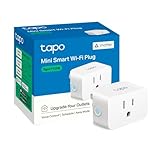
This guide covers how to install the app, what each section does, how to set schedules and Away Mode, and how to get remote access working. There’s also a section on the KP125M – the current flagship Kasa plug – for anyone who wants energy monitoring and Matter support.
How to Install the Kasa App and Create an Account
Takes about three minutes. Here’s the exact process:
If you’re upgrading from an old phone or reinstalling the app, just sign back into your existing account. All your devices, schedules, and room groupings are stored in the cloud – nothing is local to the device.
What the Kasa App Tabs Actually Do
The app is organized across three main tabs. Here’s what lives in each one.
Home Tab
This is where you’ll spend most of your time. Your devices show up as cards in a grid – tap any card to toggle it on or off, or hold to go into the device settings. You can organize devices into room groupings (Living Room, Bedroom, etc.) which makes it a lot easier once you have more than a handful of plugs.
You can also set up Scenes here – basically presets that trigger a bunch of devices at once. A “Night” scene that turns off everything except the bedroom lamp, for example. Tap the scene name to run it.
Schedule Tab
This is where you set recurring on/off timers. You pick a device, set a time (or tie it to sunrise/sunset with an offset – “15 minutes after sunset” is a genuinely useful option), choose which days of the week to repeat it, and save. Straightforward.
For more complex automations – “turn on the living room when I arrive home” – you’d need to use a third-party platform like Alexa Routines or Google Home automations instead. The Kasa app’s own scheduling is time-based only.
Energy Tab
Only visible if you have a plug with energy monitoring hardware. As of 2026, that means the KP115 or the KP125M. The tab shows real-time wattage draw, daily and monthly usage graphs, and a rough cost estimate based on your electricity rate (which you can set manually in the app settings).
It’s useful for figuring out which devices are actually drawing power when you think they’re “off” – standby draw on older TVs and desktop PCs can be surprisingly high. The KP125M is the one to buy if energy monitoring is your reason for getting a smart plug.
Remote Access – How It Works
Remote access works out of the box. There’s no extra setup, no paid tier required, nothing to configure. As long as you’re signed into your Kasa account on your phone, you can control any device on that account from anywhere – cellular, different Wi-Fi network, another country, doesn’t matter.
The plug communicates with TP-Link’s cloud servers. When you tap “on” in the app, the command routes through those servers to your plug at home. This means it also works when you’re not home, which is the whole point. The only thing that breaks remote access is if your home Wi-Fi goes down.
Away Mode
Away Mode makes a plug (or a light connected to one) turn on and off at random intervals within a time window you set. The idea is to make it look like someone’s home when you’re traveling. It’s a convincing enough deterrent – random patterns are harder to clock than a light that comes on at exactly 7pm every night.
To enable it: tap your device in the Home tab, go to the Away tab on the device page, set a start and end time, pick your days, and tap Start. You can also set the start/end times to sunrise/sunset if you want it to track seasonal changes automatically.
How to Set Up a Schedule
Tap the device you want to schedule on the Home tab
On the device page, tap the Schedule tab
Tap the + icon to create a new schedule entry
Set the action (On or Off), the time, and which days to repeat
Time options are Custom, Sunrise, or Sunset. For Sunrise/Sunset you can add an offset in minutes – useful for lights.
Tap Save
The schedule is now active. You can toggle it on/off from the Schedule tab without deleting it.
Platform Integrations
Kasa plugs work with the major smart home platforms, though the specifics depend on which plug you have.
Alexa, Google Home, and SmartThings all work via the Kasa skill – you enable it in those apps, link your Kasa account, and your devices show up automatically. Voice commands work, automations work, and everything stays in sync. That covers most of the current Kasa plug lineup.
Apple HomeKit is a different story. Most Kasa plugs don’t support it. The exception is the KP125M, which is Matter-certified. Matter is a cross-platform standard that lets a single device work with HomeKit, Alexa, Google Home, and SmartThings simultaneously – you pair it once through any Matter-compatible app and it shows up across all of them. If you’re in the Apple ecosystem and want HomeKit control, the KP125M is the only current Kasa plug that gets you there.
IFTTT used to be mentioned frequently in Kasa guides but the integration has been inconsistent and TP-Link no longer lists it as a supported platform. Stick with the native integrations above.
Troubleshooting
App Can’t Find the Plug During Setup
This is almost always a Wi-Fi issue. Kasa plugs only connect to 2.4GHz networks – if your router broadcasts a combined 2.4/5GHz network under one name, the plug should still find the 2.4GHz band, but some routers handle this poorly. If setup keeps failing, try temporarily creating a separate 2.4GHz-only SSID on your router for the pairing process.
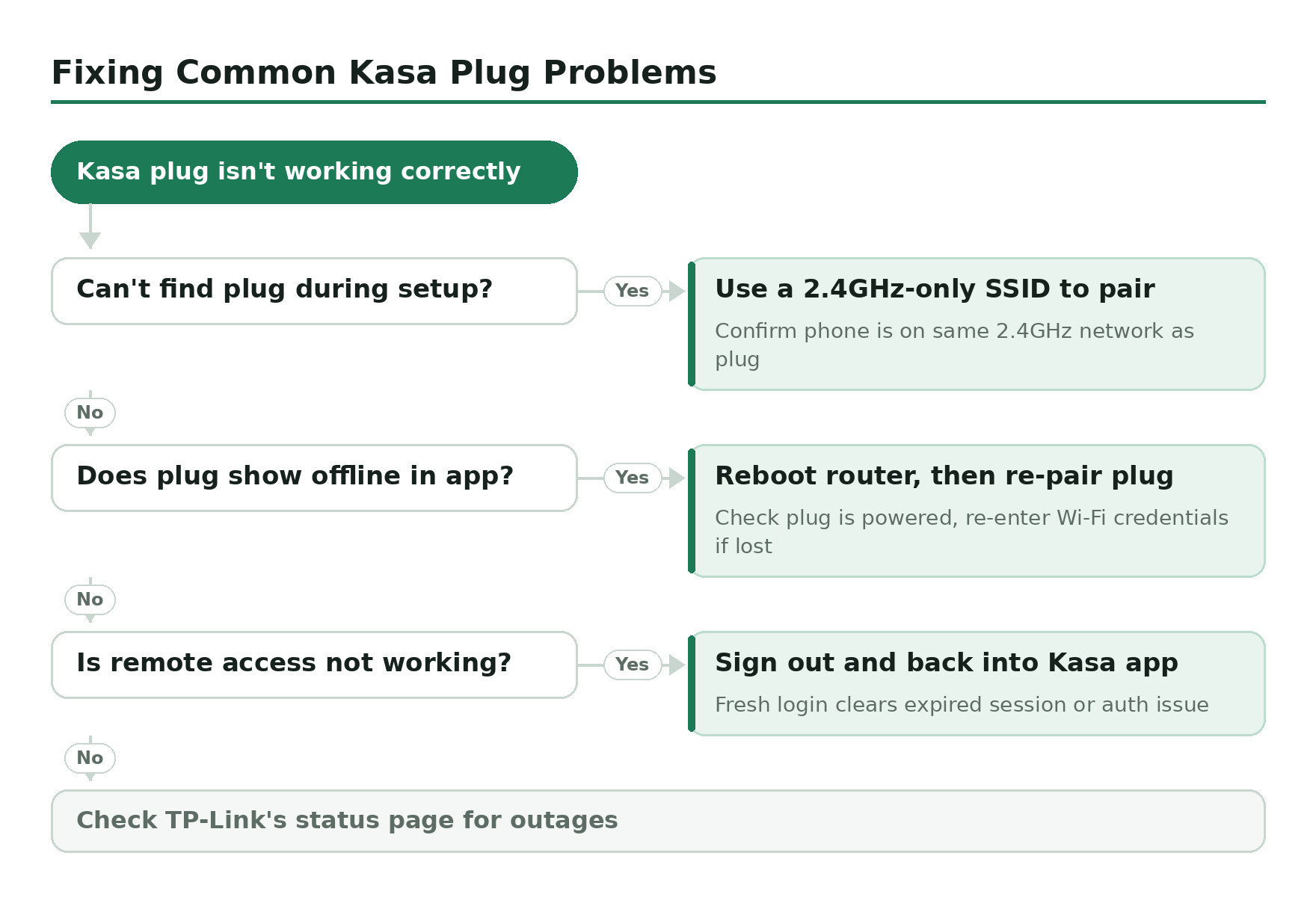
Also confirm your phone is connected to the same network you’re trying to pair the plug to. Trying to pair from a 5GHz connection to a 2.4GHz-only plug causes the app to hang.
Plug Shows as Offline in the App
First check: is the plug actually powered? (Obvious, but.) If it’s powered, try rebooting your router. If the plug still shows offline after the router is back up, open the Kasa app, go to the device, and check Settings – sometimes the plug has lost its Wi-Fi credentials after a network change (new router, changed password) and needs to be re-paired.
Remote Access Not Working
Sign out of the Kasa app completely and sign back in. Remote access runs through TP-Link’s cloud, so if your account session has expired or there’s an auth issue, a fresh login usually clears it. If that doesn’t work, check TP-Link’s status page – they do have occasional server outages that affect remote access sitewide.
FAQ
Does the Kasa app require a subscription?
No. The core features – remote control, scheduling, Away Mode, energy monitoring, voice integration – are all free. Kasa Care is an optional paid subscription for camera cloud video storage only. If you’re only using smart plugs, you’ll never need it.
Does the Kasa Smart Plug work with the Smart Life app?
No. Kasa plugs only work with the Kasa Smart app, or through third-party integrations like Alexa, Google Home, and SmartThings. The Smart Life app is for Tuya-based devices, which use a different protocol.
Do you need the Kasa app to use a Kasa plug?
You need the app for initial setup – the plug won’t connect to your Wi-Fi without it. After that, if you’ve set it up with Alexa or Google Home, you can control it from those platforms without opening the Kasa app. But the app is how you manage schedules, Away Mode, and energy monitoring.
Will the Kasa app work with the Amazon Smart Plug?
No. The Amazon Smart Plug is a separate device made by Amazon. It uses Alexa as its control interface, not the Kasa app. They’re entirely different ecosystems.
Which Kasa plug supports Apple HomeKit?
The KP125M, via Matter. Most other Kasa plugs don’t support HomeKit. If HomeKit compatibility matters to you, the KP125M is your only option in the current Kasa lineup.
For a deeper look at what you can actually do once everything is set up, see the guide on Kasa Smart Plug uses. If you’re hitting problems during or after setup, the Kasa Smart Plug troubleshooting guide covers the most common issues in detail.
Still Using Kasa? Here’s the Upgrade.
Kasa smart plugs still work, but TP-Link has been winding the brand down in favor of Tapo. The KP125M is no longer sold new through most major retailers, and older models like the EP25 are fully discontinued.
The direct replacement is the Tapo P125M – same compact design, same energy monitoring and scheduling, but with Matter certification added. That means it connects directly to Apple Home, Google Home, or SmartThings without needing a cloud account. If you’re already on the Kasa app, the Tapo app is nearly identical.