
This post contains affiliate links. If you buy through them, DumbSwitches may earn a commission at no extra cost to you. See our full disclosure.
Yes, but there’s no native Geeni desktop app and there never has been. The two options that actually work in 2026 are Geeni’s own browser-based viewer at camview.mygeeni.com (paired to your phone via QR code) and an Android emulator like BlueStacks running the regular Geeni mobile app. Everything else marketed as a “Geeni for PC download” is either an emulator wrapper or a malware-laced impostor.

The short version
- Easiest path: Geeni Camview at camview.mygeeni.com – log in with your Geeni account or scan a QR code from the app. Works in Chrome on any computer. Live view only, no playback of cloud or SD-card recordings.
- Full-featured path: Install BlueStacks (or LDPlayer), install the Geeni Android app inside it, log in. You get the full mobile app on a desktop window, including playback.
- RTSP / ONVIF: Geeni cameras are Tuya-based and do not expose RTSP or ONVIF streams out of the box. Community workarounds exist but require flashing custom firmware and will void your warranty.
- What absolutely does not work: any “Geeni for Windows” download from a third-party site, any Microsoft Store result claiming to be the official Geeni app, and any Mac App Store listing for Geeni. None exist.
Option 1: Geeni Camview (the official web viewer)
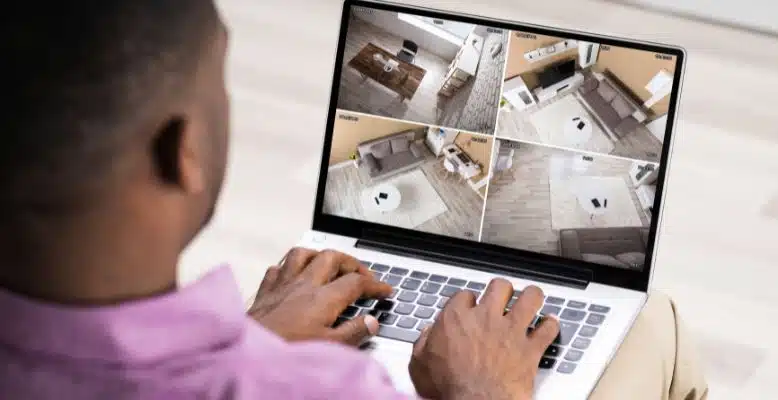
This is the answer most older guides miss. Geeni quietly added a browser-based camera viewer at camview.mygeeni.com. It’s a thin wrapper around the same Tuya web client that powers similar viewers for Smart Life, eufy, and a dozen other Tuya-rebrands, but it works and it’s free.
Caveats before you get excited: it only does live view, it generally only works with Wi-Fi cameras that are plugged into mains power (battery-powered Geeni cams sometimes refuse to wake up for the web session), and you have to use a Chromium-based browser. Safari and Firefox can load the page but the video stream itself often fails to negotiate.
Open Chrome (or Edge) and go to camview.mygeeni.com.
Sign in with the same email and password you use for the Geeni mobile app, or click the QR-code option.
If you chose QR: open the Geeni app on your phone, tap Me, tap the scan icon in the top corner, and scan the QR code on the web page.
Pick the camera you want to view from the list on the left. The live feed loads in the main panel.
Drag a second, third, or fourth camera into the grid to view up to nine feeds at once.
If the page loads but the video never starts, open the camera’s settings inside the Geeni mobile app, toggle the camera off and back on, and refresh Camview. Tuya’s WebRTC handoff between the mobile session and the web session is fragile – this fixes it about nine times out of ten.
Option 2: Android emulator (BlueStacks or LDPlayer)
If you want playback, cloud-clip review, or device settings – things Camview doesn’t do – install an Android emulator and run the actual Geeni mobile app inside it. BlueStacks is the most widely supported. LDPlayer and NoxPlayer also work; whichever you pick, expect a Windows install size of around 5 GB and a meaningful chunk of RAM while running.
Download BlueStacks from bluestacks.com and install it. Accept the default options.
Launch BlueStacks and sign in with a Google account. This is just for Play Store access – no Geeni data is shared with Google.
Open the Play Store inside BlueStacks. Search for Geeni – Smart Home. Install it.
Open the Geeni app and sign in with your existing Geeni credentials. Do not register a new account – your cameras will not migrate.
All your existing cameras appear in the device list. Tap any camera to live-view it on your desktop.
On a Mac the situation is messier. BlueStacks has dropped official macOS support on Apple Silicon and the Intel build is creaky. The reasonable Mac alternatives are BlueStacks Air for Mac (Apple Silicon native, requires macOS 12+) or running an Android virtual machine in Google’s Android Studio emulator. The Android Studio path is free but takes about twenty minutes of fiddling to get right.
RTSP, ONVIF, and the truth about “open” Geeni cameras
Geeni cameras are made by Merkury Innovations and run firmware built on the Tuya IoT platform. Tuya cameras, as shipped, do not speak RTSP or ONVIF. That kills the obvious power-user move (point Blue Iris or Synology Surveillance Station at the camera and skip the app entirely).
There are community projects that flash custom firmware to enable RTSP – tuya-cloudcutter and similar – but they require a specific chipset, a Linux setup, an evening of frustration, and they void any warranty Geeni would honor. If RTSP matters to you, buy a camera that supports it natively. The cost of a Reolink or Amcrest indoor cam is lower than the time it takes to make a Geeni speak ONVIF.
The scam apps you will see in search results
Search “Geeni for PC” and the first three results are unaffiliated sites with names like geeni-app.com, geeniforpc.web.app, and geenicamera.vercel.app. None of these are run by Merkury Innovations. The Geeni app does not exist in the Microsoft Store or the Mac App Store – if you see one there, it isn’t real.
Best case those sites point you at the same BlueStacks workflow described above, wrapped in display ads. Worst case the “installer” they hand you is a remote access trojan. Either way you don’t need them. Use Camview, or install BlueStacks directly from bluestacks.com.
Should you actually be using Geeni for desktop viewing?
Honest answer: no, not if desktop monitoring is your main use case. Geeni is a budget mobile-first ecosystem and the web viewer is a side feature Tuya bolted on. You get live feeds and that’s it – no continuous recording to your computer, no smart alerts pushed to a desktop client, no clip review without bouncing through the phone.
If you want cameras that genuinely belong on a computer screen, the categories that do it well are:
- UniFi Protect – Ubiquiti’s local NVR system. Full browser console at unifi.ui.com, multi-camera grids, motion timeline, AI detection. The catch is hardware cost: you need a Protect-capable console (Dream Machine, Cloud Gateway, NVR) plus the cameras.
- Synology Surveillance Station – if you already own a Synology NAS, you get two free camera licenses and one of the best desktop surveillance UIs on the market. Pairs nicely with any ONVIF camera (Reolink, Amcrest, Hikvision).
- Reolink with the desktop client – cheaper than UniFi, ONVIF-native, with a real Windows and Mac client that does live view, playback, and motion alerts without an emulator.
The Geeni route makes sense if you’ve already invested in a few Geeni cameras and just want a bigger screen occasionally. It does not make sense as a green-field choice for someone planning a desktop-centric setup.
Watching Geeni on a TV (because that’s the next question)
Android TV is the path of least resistance. The Geeni app is on the Google Play Store for Android TV – install it, sign in, watch. For a Roku or an Apple TV there’s no official Geeni app, but if you’ve got an iPhone or an Android phone you can AirPlay or Cast the Geeni app’s live view onto the TV instead.
The four-camera grid view that the app does on a phone scales up reasonably to a TV. Beyond four feeds the bandwidth gets messy on 2.4 GHz Wi-Fi (Geeni cams are 2.4 GHz only), so don’t try to drive eight cameras to one TV unless they’re spread across multiple access points.
Troubleshooting common desktop-viewing problems
Camview loads but the camera tile is grey
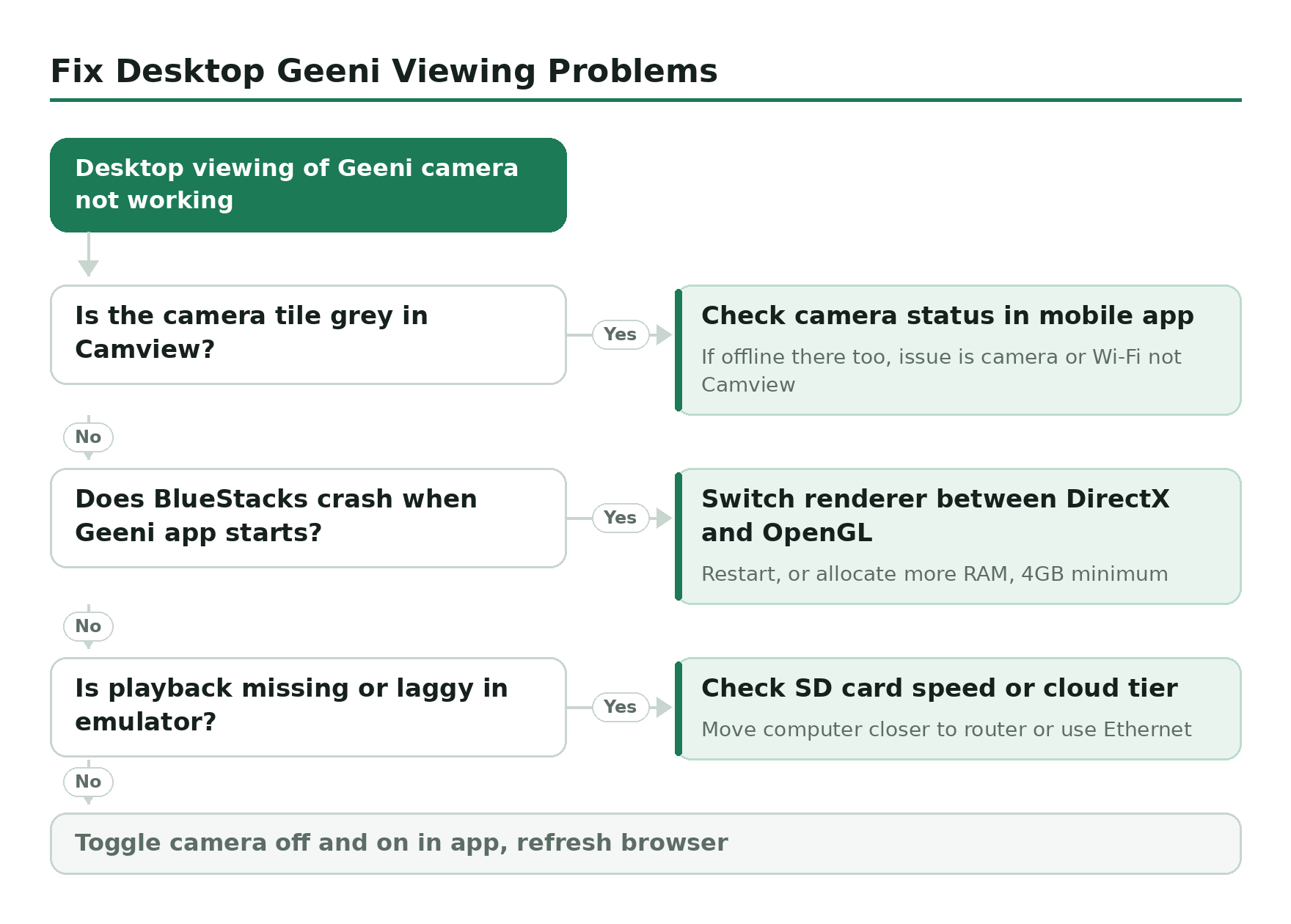
The web session can’t reach the camera. Check the Geeni mobile app first – if the same camera is offline there, the issue is the camera or the Wi-Fi, not Camview. If the camera is online in the mobile app but grey in Camview, toggle the camera off and on in the app, then refresh the browser tab.
BlueStacks crashes when the Geeni app starts
Almost always a graphics-driver issue. In BlueStacks settings, switch the renderer between DirectX and OpenGL and restart. If that doesn’t work, allocate more RAM to the emulator (4 GB minimum, 6 GB if you can spare it).
Live view works but playback is missing or laggy
Camview doesn’t do recorded playback at all – that’s expected. In the emulator, playback lag usually traces back to either a slow SD card in the camera or a Geeni Cloud subscription tier that throttles older clips. If both your camera and device are on 2.4 GHz Wi-Fi, move the computer closer to the router or use Ethernet.
Related guides
- What is the Geeni app? – the hub guide covering everything Geeni’s mobile app does.
- Geeni camera setup – getting a brand-new Geeni cam online before you worry about desktop access.
- Geeni camera troubleshooting – what to do when the camera itself is the problem.
- Geeni camera storage options – cloud vs SD card and what each tier actually buys you.
- Geeni app alternatives – if you’re hitting the limits of Geeni’s ecosystem.