

This post contains affiliate links. If you buy through them, DumbSwitches may earn a commission at no extra cost to you. See our full disclosure.
A red light on a Geeni camera almost always means one of two things: the camera is in pairing mode and waiting for setup, or it has fallen off your Wi-Fi and can’t get back on. Blue means the opposite – solid blue is “connected and happy,” blinking blue is “I had a connection a moment ago and I’m trying to find it again.” That’s the whole map. The details that actually matter are below.

The quick decoder
If you just want the answer for your specific blink pattern, this list covers it. Geeni’s current lineup uses the same LED scheme across the Look, Vivid, Hawk 3, Lookout, Perch, Falcon, Halo doorbell, and most older Merkury Innovations branded models.
- Solid red – the camera just powered on or just got reset, and it’s about to enter pairing mode. You’ll usually hear a chime, then the light will switch to blinking red on its own.
- Blinking red – pairing mode. The camera is broadcasting itself and waiting for the Geeni app to show it a QR code. This is the state you want to be in when you’re adding a camera.
- Solid blue – connected to Wi-Fi and online. Nothing to fix.
- Blinking blue – the camera has lost its Wi-Fi connection and is trying to reconnect. It’ll keep trying on a loop until either Wi-Fi comes back or you reset it.
- Red glow at night, around the lens – that’s the infrared LEDs for night vision, not a status light. It’s supposed to do that. You can disable it in the Geeni app under the camera’s settings if it bothers you.
- No LED at all but the app says online – some models let you turn the status indicator off in settings to be less conspicuous. Check the app before assuming the camera is dead.
Solid red vs blinking red – it matters
This is the part older guides get wrong. Solid red is a brief startup state – it’s what you see for a few seconds right after you plug the camera in, or right after you’ve held the reset button down. The camera plays a tone, the light goes solid red, then it switches to blinking red on its own. Blinking red is the actionable state. That’s “I’m ready to be paired, please open the Geeni app.”
If your camera is sitting on solid red for more than about 20 seconds without ever transitioning to blinking, something interrupted the boot sequence – usually a flaky USB cable on an indoor model, or a half-charged battery on the Perch or Falcon. Unplug it, wait ten seconds, plug it back in. If it still sticks on solid red, try a different cable before assuming the camera is broken.
Why the camera is stuck on blinking red
Two scenarios: you’re trying to set it up and it can’t see your phone’s QR code, or it’s an already-paired camera that lost its Wi-Fi configuration and dropped back to pairing mode on its own.
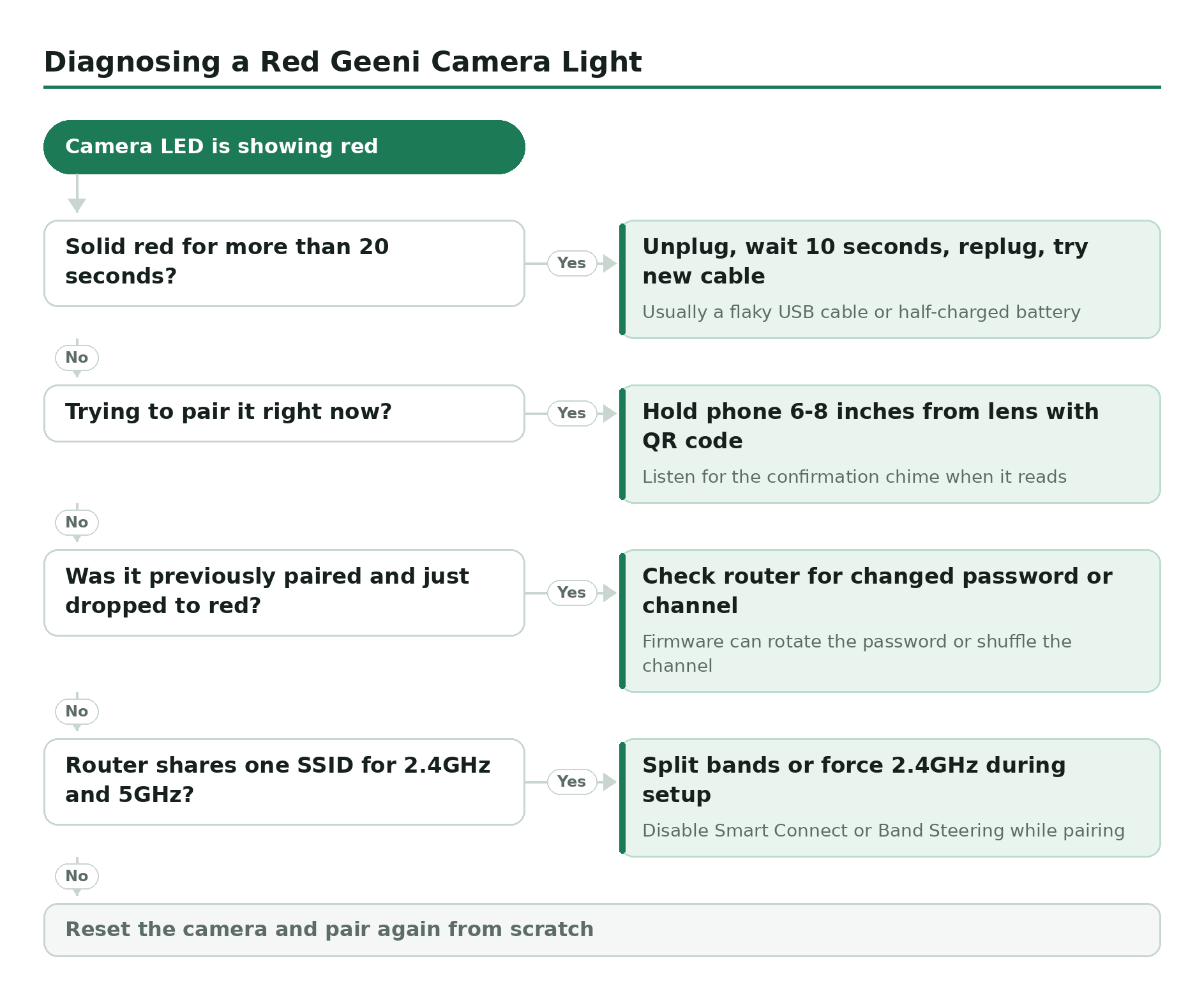
For the QR code scenario, the most common cause is distance. Geeni’s official guidance is to hold your phone six to eight inches in front of the camera lens while the QR code is on screen. Closer than that and the camera can’t focus; farther and the QR code is too small. You’ll hear a confirmation chime when it reads the code – if you never hear the chime, it never saw the code.
For the “it used to work and now it’s blinking red again” scenario, your router probably changed something. A firmware update can rotate the Wi-Fi password or shuffle the channel; some mesh routers will silently move a 2.4 GHz device onto a 5 GHz band that Geeni cameras can’t see. Worth checking your router admin page before you reset anything.
Why the camera is blinking blue
Blinking blue is the camera saying “I was online a minute ago and now I’m not.” It keeps the previous network credentials in memory and tries to reconnect every few minutes. If the outage is brief (router rebooted, ISP hiccup), the light will go back to solid blue on its own and the app will show the camera online again within five to ten minutes.
If it’s still blinking blue an hour later, the network either isn’t there anymore (you replaced your router, changed the SSID, or rotated the password) or the camera’s Wi-Fi chip has wandered off. Power-cycle it. If that doesn’t bring it back, you’ll need to delete it from the Geeni app and pair it again from scratch.
Geeni cameras only use 2.4 GHz Wi-Fi
This trips up more people than any other single issue. Geeni cameras – every model, indoor or outdoor – connect to 2.4 GHz Wi-Fi only. They cannot see 5 GHz networks at all. If you’ve got a newer router that broadcasts both bands under the same SSID and lets the router decide which one a device gets, it will sometimes shove the camera onto 5 GHz during setup, the camera will fail to connect, and you’ll see solid or blinking red forever.
The fix is either to temporarily split your bands (give 2.4 GHz its own SSID), or to use your router’s app to force the camera onto the 2.4 GHz band during setup. On most modern routers there’s also a “Smart Connect” or “Band Steering” toggle you can disable for the duration of pairing. Once the camera is paired, you can usually turn it back on.
Getting back to pairing mode – the reset
When nothing else works, you reset. The reset hole is on the bottom of indoor cameras like the Look and Vivid, on the back of outdoor models like the Hawk 3 and Lookout, and inside the battery compartment on the Falcon and Perch. You’ll need a paperclip or SIM tool.
Make sure the camera is powered on and the LED is visible.
Insert a paperclip into the reset pinhole and press the button firmly.
Hold the reset button for about five seconds, until you hear a prompt tone from the camera.
Release the reset button. The LED should go solid red, then start blinking red within a few seconds.
Open the Geeni app, tap the plus icon, choose Wi-Fi Camera, and follow the prompts to pair it again.
The LED is your confirmation that the reset worked. If you don’t get the prompt tone and the light doesn’t change after holding for ten seconds, you’re either not pressing the button hard enough or you’ve got the wrong pinhole (some outdoor models have a microphone hole near the reset button – they look similar).
“My camera’s light is red but the app says it’s online”
This one comes up enough to deserve its own section. If the LED is glowing red but the Geeni app shows the camera as online and you can pull a live feed, the red glow you’re seeing is the infrared night-vision array, not a status warning. It only switches on when the ambient light gets low enough for the camera to think it’s nighttime, which is why you usually notice it in the evening or in a dim room.
If you don’t want the red glow visible at night (a common request for indoor cameras pointed at a bedroom), open the Geeni app, go into the camera’s settings, and look for an “Infrared Night Vision” or “IR Night Mode” toggle. Switching it to off kills the red. The trade-off is that you’ll get no usable image in the dark – the camera will just show black until something with a light turns on.
When the LED behavior differs across models
The basic red/blue scheme above is consistent across the Geeni lineup, but a few specific models add small wrinkles worth knowing:
- Geeni Look and Vivid (indoor) – the cleanest LED behavior; matches the quick decoder above exactly. The Geeni Look 1080p is the workhorse model most setup tutorials are written against.
- Geeni Hawk 3 (outdoor) – the Hawk 3 2K uses the same LED scheme plus an extra integrated LED floodlight that comes on with motion. Don’t confuse the floodlight switching on for a status change.
- Geeni Halo doorbell – the LED is the ring around the button, not a discrete pinpoint indicator. The colors mean the same thing, but the ring is much easier to see in daylight than a single LED, which trips people up.
- Geeni Falcon and Perch (battery-powered) – these go into low-power standby between events, and the status LED switches off in standby to save battery. A camera that “has no light” might just be sleeping. Pull a live view from the app to wake it.
The hub doesn’t have a light – the camera does
One last thing worth saying because it comes up: Geeni cameras don’t use a hub. There’s nothing else with a status light to check. If you’re used to other ecosystems (Blink Sync Modules, Ring Bridges, Hue Bridges) and you’re hunting for “the other LED that explains the problem,” there isn’t one. Whatever the camera’s LED is showing you is the whole story.
Related guides
- What is the Geeni app – the controller that pairs with all of these cameras.
- Install, set up, and use the Geeni app – if you’re new to the ecosystem, start here before you try to pair a camera.
- Geeni camera setup walkthrough – the full QR-code pairing flow with screenshots.
- Geeni camera troubleshooting – covers connection, recording, and motion-detection issues beyond just the LED.
- Can I view my Geeni camera on a computer – desktop access options if you don’t want to live in the phone app.
- Can Geeni cameras be hacked – the security and privacy picture before you put one in a bedroom.