
This post contains affiliate links. If you buy through them, DumbSwitches may earn a commission at no extra cost to you. See our full disclosure.
The Philips Hue Go 2 is a good lamp for a very specific person. If you want a portable, battery-powered color light you can move from the coffee table to the garden without thinking about it, and you’re already in the Hue ecosystem, it’s a no-brainer. If you’re not in that ecosystem – or you just want something bright to read by – it’s probably not for you.
It’s still a current product in 2026, available at around $99, and Philips hasn’t replaced it with anything. That kind of staying power usually means it found its audience.
What You’re Actually Getting
The Hue Go 2 is a bowl-shaped LED accent light with a built-in rechargeable battery. It does full color (16 million colors, 2000K – 6500K color temperature range), peaks at 520 lumens, and runs on either Bluetooth alone or through a Hue Bridge for full smart home integration.
520 lumens sounds decent until you remember that’s about the output of a 40W incandescent. Fine for ambient light on a side table. Not fine if you’re trying to actually see something.
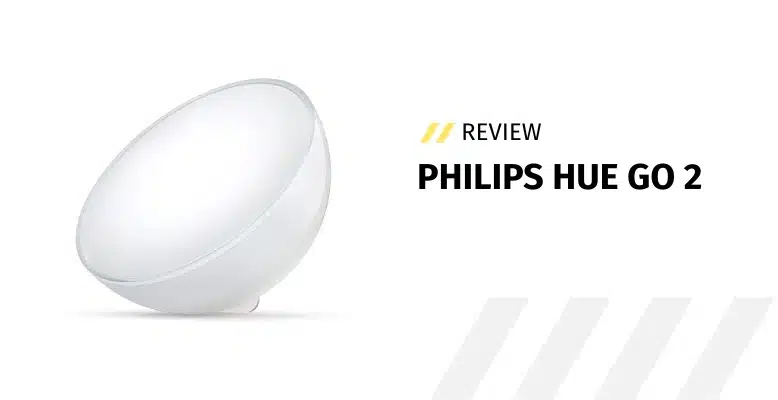
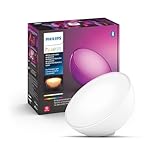
The design is worth mentioning: it’s a flattened globe that can sit upright like a bowl or tilt sideways to act as a proper table lamp. The charging port is on the side (fixed from the Gen 1, where Philips somehow put it on the bottom, making it impossible to use while plugged in).
Battery Life: The Honest Version
Philips claims up to 24 hours. That number is real – technically. It refers to the Nightlight preset, which is basically a dim warm glow. At full brightness, you’re looking at 2.5 – 3 hours. The full breakdown by preset:
| Preset | Battery Life |
|---|---|
| Nightlight | ~24h |
| Cozy Candle | ~18h |
| Night Adventure | ~12h |
| Enchanted Forest / Dimmed | ~10h |
| Relax | ~4.5h |
| Meditation / Sunday Coffee | ~3h |
| Read / Concentration / Energize | ~2.5h |
For a dinner party on the patio or a long evening of ambient light at low brightness, that’s genuinely useful. For anything requiring the light to do actual work, you’ll be plugging it in. Charging goes from 0 to full in 2 hours.
There’s also a battery save mode (hold the button for 10 seconds) that cuts wireless connectivity to extend runtime. Useful if you just want it on and don’t need app control.
Bridge or No Bridge – Your Call
This is where the Hue Go 2 is more practical than most Hue products. You can run it entirely via Bluetooth with the Hue Bluetooth app – no Bridge, no hub, no ecosystem commitment. Download the app, connect, done.
Go with a Bridge and you unlock automations, routines, scenes, and all the usual Hue intelligence. It also gets you native Apple HomeKit support, Alexa, and Google Home. The Hue Bridge also supports Matter as of 2023, so it plays nicely with whatever platform you’re building around.
The physical button on the device itself handles the basics without any app: single press cycles through light effects, double-press-and-hold browses colors, long press puts it in standby.
Setting It Up
Charge it first
Plug in the included power adapter and charge fully before first use. Takes about 2 hours from empty.
Download the Hue Bluetooth app
For standalone use, grab the Hue Bluetooth app (iOS or Android). If you already have a Hue Bridge, use the main Hue app instead.
Turn on the Go and open the app
Press the button on the device to power it on. The app will detect it via Bluetooth and walk you through pairing.
Add to a room and set a scene
Assign it to a room in the app. From there you can pick from preset scenes or set a custom color. If you’re on a Bridge, add it to any existing room or zone.
The Verdict
The Hue Go 2 does what it says. It’s a portable, battery-powered color accent light that integrates cleanly into the Hue ecosystem. The 24-hour battery claim is technically accurate but only at low brightness settings – treat it more like 3-10 hours for real-world use with actual color output.
At $99, it’s expensive for something that’s fundamentally an ambient accent light. You’re paying for the Hue integration, the color range, and the portability. If those three things matter to you, it’s worth it. If any one of them doesn’t – look elsewhere.
Pick one up on Amazon or direct from Philips.
Summary
The Good
- Bluetooth + Zigbee – works with or without a Bridge
- Native HomeKit, Alexa, and Google Home support
- Matter support via Hue Bridge
- Long battery life at low brightness (up to 24h)
- Works plugged in as a permanent lamp
The Bad
- Only 2.5 – 3h battery at full brightness
- 520 lumens – not useful for task lighting
- $99 is steep for an accent light
- No automations in standalone Bluetooth mode
FAQ
How bright is the Philips Hue Go 2?
520 lumens maximum. Color temperature runs 2000K – 6500K. It supports 16 million colors and draws 6 watts. That’s enough for ambient or accent lighting – not enough for reading or task lighting.
How do you sync Philips Hue Go with music?
The Philips Hue Sync app (Windows and macOS) can sync the Go with music or video. On mobile, there’s no official sync app, but third-party options like HueDynamic and Hue Disco work.
Does the Philips Hue Go 2 need a Bridge?
No. It connects via Bluetooth using the Hue Bluetooth app and works fully standalone. Add a Hue Bridge to unlock automations, HomeKit, and the full feature set.
How long does the Philips Hue Go 2 last?
The LED is rated for 20,000 hours of total runtime and 50,000 on/off cycles. The battery life per charge ranges from about 2.5 hours at full brightness to 24 hours at the dimmest Nightlight preset.
Does the Philips Hue Go 2 support Matter?
Yes, via the Hue Bridge. The Bridge has supported Matter since 2023, which means all Hue devices connected to it – including the Go 2 – are accessible to Matter-compatible platforms like Apple Home, Google Home, and SmartThings.
What is the difference between Hue Go v1 and v2?
The Go 2 added Bluetooth connectivity (v1 required a Bridge), nearly doubled the brightness from 300 to 520 lumens, massively improved battery life, and moved the charging port from the bottom to the side so the lamp can actually stand upright while charging.
How long does the Philips Hue Go 2 take to charge?
About 2 hours from empty to full.