This post contains affiliate links. If you buy through them, DumbSwitches may earn a commission at no extra cost to you. See our full disclosure.
Short answer: no, Sonos does not support Apple HomeKit natively. Sonos speakers won't show up in the Home app as controllable accessories the way a Philips Hue bulb or a smart lock does. But there's a longer answer, and it's more useful – because Sonos does support AirPlay 2, which gets you most of what you're probably after anyway.
AirPlay 2 vs HomeKit – What's the Difference?
People mix these up constantly, so it's worth being clear about what each one actually does.
HomeKit is Apple's smart home framework. Devices with native HomeKit support appear in the Apple Home app as controllable accessories. You can build automations around them, trigger them with scenes, and treat them like first-class smart home devices. Think light switches, thermostats, door locks.
AirPlay 2 is a streaming protocol. It lets you beam audio from your iPhone, iPad, or Mac to compatible speakers. Devices that support AirPlay 2 can appear in the Apple Home app – but only for the purpose of streaming audio to them. You can play music, pause it, and change the volume. That's roughly where it ends.
Sonos supports AirPlay 2 on most of its current lineup. It does not support native HomeKit. Those are two different things, and the distinction matters when you're deciding what level of Apple integration you actually get.
What You Can Do With Sonos and Apple
With AirPlay 2, you can:
- Stream audio from any Apple device to Sonos speakers
- Control playback (play, pause, skip, volume) through the Apple Home app
- Ask Siri on your iPhone or iPad to play music on specific Sonos speakers – “Hey Siri, play jazz in the kitchen”
- Include Sonos speakers in multi-room audio setups alongside other AirPlay 2 devices
- Trigger Sonos playback as part of Apple Home automations (with limitations)
Note the Siri caveat: you're using Siri on your phone, not on the Sonos speaker itself. Siri isn't baked into Sonos hardware. The command goes through your iPhone, which then sends the instruction over AirPlay 2. It works – just not the same as walking into a room and talking to the speaker.
What you cannot do: deep HomeKit automations, using Sonos as a trigger device in Home scenes, or treating it like a proper HomeKit accessory that responds to home/away states and time-based triggers the way a smart switch would.
Current AirPlay 2-compatible Sonos speakers include the Era 100, Era 300, Arc, Arc Ultra, Beam (Gen 2), Move 2, Roam 2, and Port, among others. The original Play:1 and Playbar are not AirPlay 2 compatible.
If you're looking for a current Sonos speaker, the Sonos Era 100 is the everyday pick – full AirPlay 2 support, solid sound, reasonable price. The Sonos Era 300 is the premium option if you want Dolby Atmos spatial audio.
What About Matter?
Sonos joined the Matter alliance back in 2022, which raised hopes of proper HomeKit integration down the road. As of 2026, it hasn't happened. The Matter specification still doesn't have a finalized audio/speaker standard, so there's no timeline for when or whether Sonos devices will become full HomeKit accessories via Matter. Worth watching, but don't hold off a purchase waiting for it.
The Homebridge Path
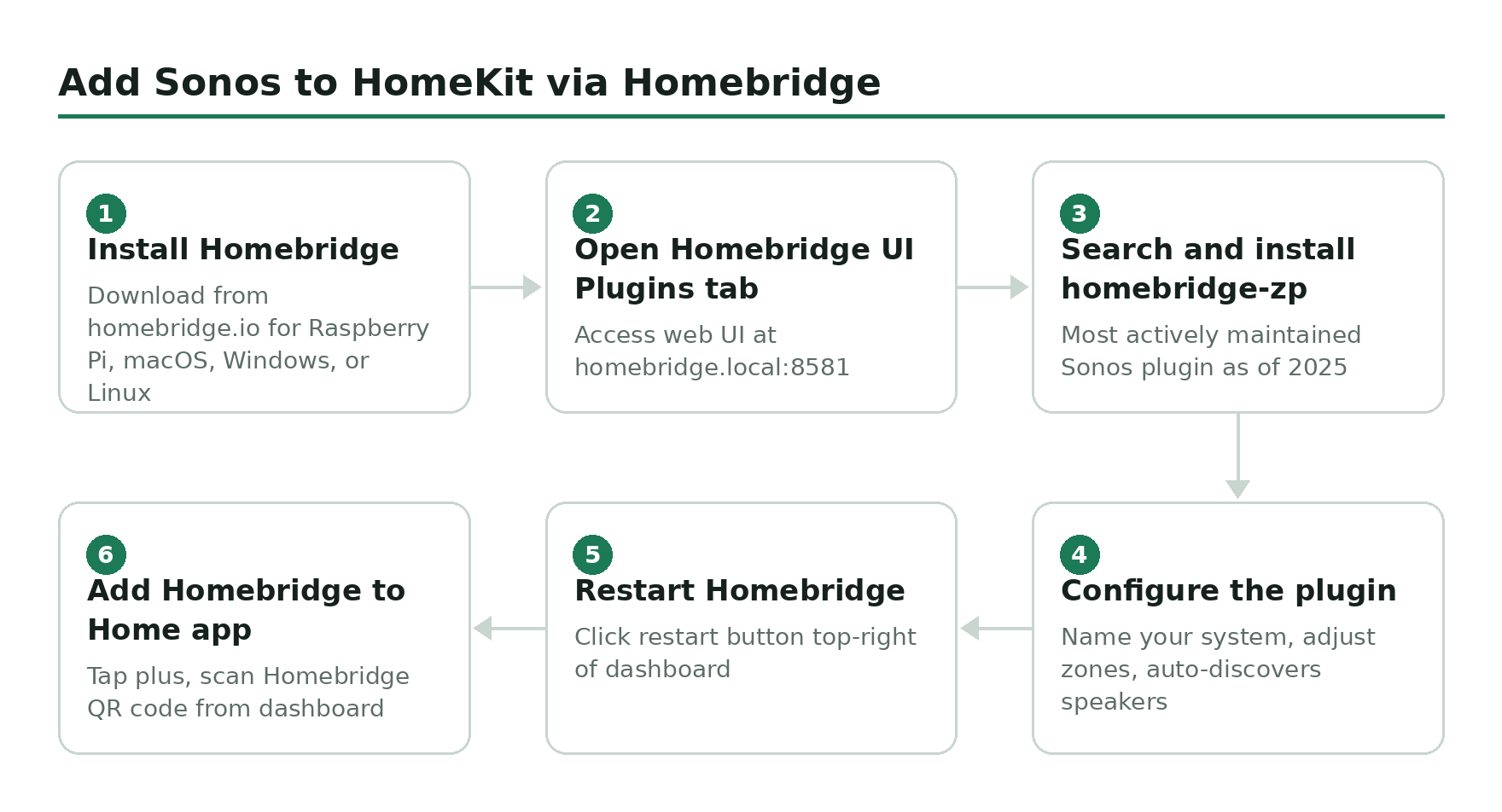
If you want deeper HomeKit control – the kind where Sonos actually appears as a proper accessory in the Home app – Homebridge is the way to do it. Homebridge is free, open-source software that runs on a Raspberry Pi, Mac, or any always-on computer. It bridges non-HomeKit devices into HomeKit by running plugins that translate their APIs.
The main Sonos plugin for Homebridge is homebridge-zp (maintained by Erik Baauw, last updated 2025). It exposes Sonos zone players to HomeKit with real-time state monitoring per group and zone. There are a couple of simpler alternatives (homebridge-sonos, homebridge-sonos-so-simple) if you just need basic on/off and volume control.
A few caveats: HomeKit doesn't have a native “speaker” accessory category, so volume typically shows up as a light dimmer or fan speed – which is as weird as it sounds but functional. You'll also need a device running Homebridge 24/7 for this to be reliable. If that sounds like more infrastructure than you want to manage, AirPlay 2 probably covers 90% of what most people need anyway.
How to Add Sonos to Apple HomeKit via Homebridge