
This post contains affiliate links. If you buy through them, DumbSwitches may earn a commission at no extra cost to you. See our full disclosure.
Yes, Hubitat can control WiFi devices – but “WiFi support” means a few different things depending on the device, and knowing the distinction saves you a lot of frustration. Some WiFi devices work natively via LAN. Others work through Matter (the cleanest path in 2026). And a long tail of brands work through community-built drivers that communicate over your local network without touching the cloud.

The short version: if a device supports Matter, Hubitat handles it natively. If it doesn’t, there’s a very good chance the Hubitat community has a driver for it anyway. The days of WiFi devices being second-class citizens in Hubitat are mostly over.
Native WiFi Support vs. Community Drivers
Hubitat’s primary radio protocols are Zigbee 3.0 and Z-Wave – those are the first-class citizens. WiFi devices plug in through a few different paths:
- Built-in LAN integrations: Hubitat ships with native support for several popular WiFi-connected brands, including Lutron (Caseta, RadioRA2), Philips Hue (via the Hue Bridge), Sonos, LIFX, WiZ, Meross, and others. These work out of the box, no community driver needed.
- Matter over WiFi: Any Matter-certified device that runs on WiFi can be paired directly to Hubitat. This is the cleanest integration – local, standardized, no quirks. More on this below.
- Community drivers: The Hubitat Package Manager (HPM) gives you access to hundreds of community-built drivers. Tuya-based devices (which cover a massive portion of the cheap WiFi smart home market), TP-Link Kasa, Shelly, and many others have solid community drivers that run locally on your LAN.
- Cloud integrations: Some brands connect via cloud-to-cloud. It works, but you lose local control – automations depend on the manufacturer’s servers staying up. Avoid this path where possible.
The key thing to know: Hubitat is fundamentally a local-control hub. It doesn’t require a cloud subscription to run, and most WiFi integrations – especially Matter and LAN-based community drivers – keep your automations running even if the internet goes down.
Matter as the Clean WiFi Path
Matter is the smart home interoperability standard backed by Apple, Google, Amazon, and others – and Hubitat has supported it since 2024. The current flagship, the Hubitat C-8 Pro, is a full Matter 1.5 controller as of platform update 2.4.4.
What that means practically: any Matter-certified WiFi device – bulbs, plugs, thermostats, sensors, locks, robot vacuums, air quality sensors – can be paired directly to Hubitat using the mobile app. You scan the Matter QR code, Hubitat commissions the device, and it appears in your dashboard like any other device.
A few things worth knowing about Matter on Hubitat:
- Multi-admin support: Matter devices can be paired to multiple controllers at once. If you already have a device in Alexa or Apple Home, you can add it to Hubitat without removing it from the other platform.
- Mobile app required for commissioning: Matter over WiFi devices must be added using the Hubitat mobile app (version 2.1.0 or later). You can’t commission them from the web dashboard.
- Hub doesn’t need to be on WiFi: Your Hubitat hub can be wired via Ethernet (recommended) and still control Matter over WiFi devices. The hub’s network connection and the device’s connection are independent.
- C-5 and newer only: Matter support requires hub model C-5 or newer. If you’re on older hardware, it’s time to upgrade.
Popular WiFi Devices That Work With Hubitat
Between native integrations, Matter, and community drivers, the list of compatible WiFi devices is long. Here are the most common categories and brands:
- Smart bulbs: Philips Hue (via Hue Bridge), LIFX, WiZ, Meross, IKEA Tradfri (via Matter or Zigbee), and Tuya-based bulbs via community drivers.
- Smart plugs: Meross, TP-Link Kasa, Shelly, Tuya/Smart Life-based plugs via community drivers or the built-in Tuya integration.
- Thermostats: Ecobee, Honeywell Home (select models), and any Matter-certified thermostat.
- Speakers: Sonos has a native built-in integration. Hubitat can trigger play/pause, set volume, and use Sonos speakers as TTS announcement devices for automations.
- Lighting controllers: Lutron Caseta and RadioRA2 (requires the Lutron Smart Bridge Pro or RA2 Repeater).
- Cameras and video doorbells: Partial support via integrations – some brands expose motion events that Hubitat can use as triggers.
If you’re shopping for new devices and want the simplest experience, look for the Matter logo. If you’re trying to integrate something you already own, search the Hubitat community forum and Hubitat Package Manager first – the driver you need probably already exists.
How to Add a WiFi Device to Hubitat
The process varies slightly depending on the device type (Matter vs. LAN vs. community driver), but the general flow for Matter over WiFi looks like this:
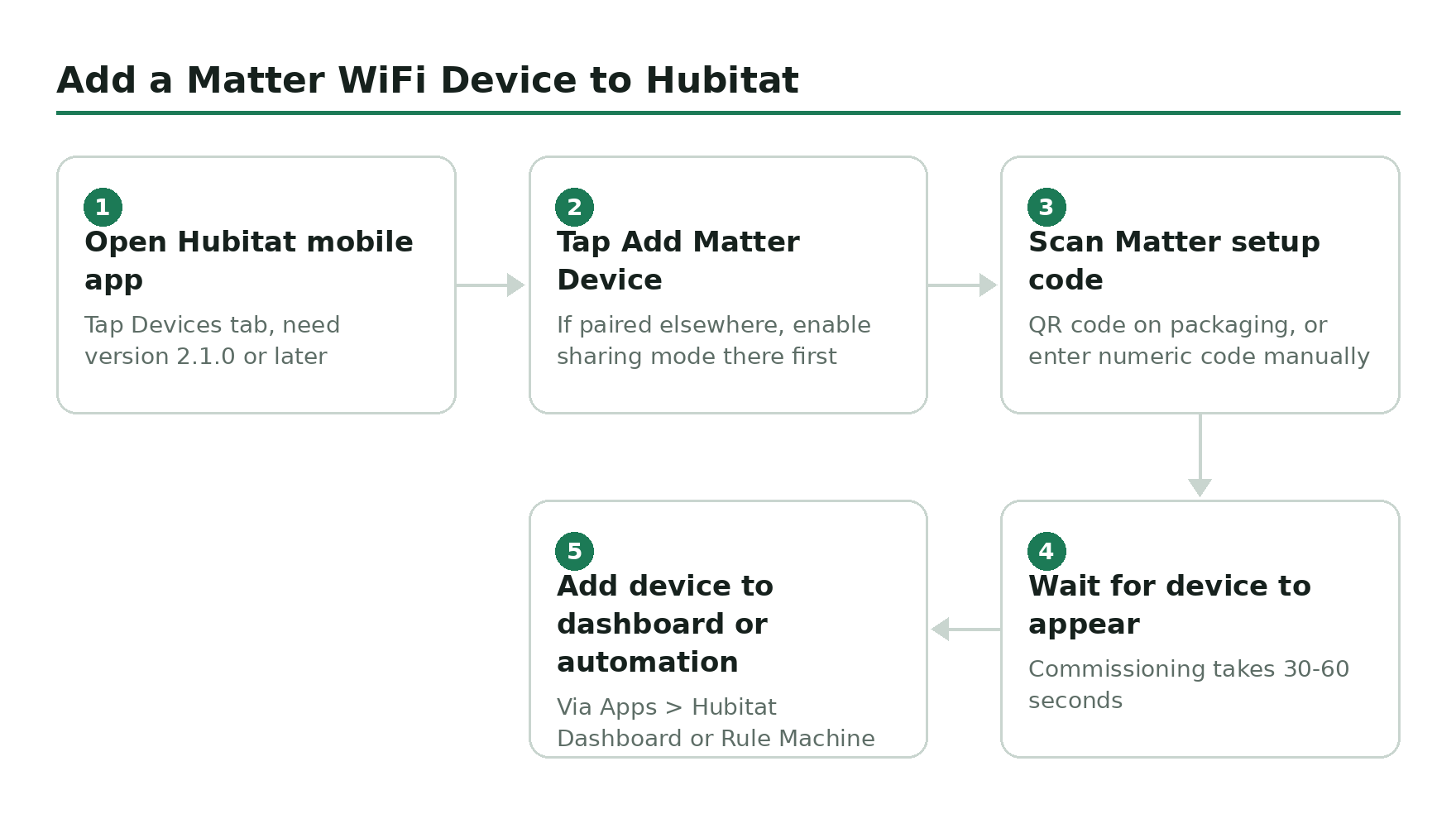
Open the Hubitat mobile app and tap the Devices tab
You need the Hubitat mobile app (iOS or Android), version 2.1.0 or later. Matter devices cannot be commissioned from the web dashboard.
Tap Add Matter Device
If the device is already paired to another platform (Alexa, Apple Home, Google Home), put it into sharing mode from that app first. This uses Matter’s multi-admin feature to add it to Hubitat without removing it from the other platform.
Scan the Matter setup code
This is the QR code on the device packaging or device itself. Some devices display a numeric code instead – you can enter that manually.
Wait for the device to appear in your hub
Commissioning takes 30-60 seconds. Once complete, the device shows up in your Hubitat device list automatically.
Add the device to a dashboard or automation
From the Hubitat web dashboard, go to Apps > Hubitat Dashboard or your automation app (Rule Machine, Simple Automation Rules, etc.) and add the newly paired device.
For LAN-based or community driver devices, the flow is similar but starts at the Hubitat web dashboard (at your hub’s local IP address) rather than the mobile app. Go to Devices > Add Device, select the driver type, and enter the device’s IP address when prompted.
Related Guides
If you’re building out your Hubitat setup, these might help: