
This post contains affiliate links. If you buy through them, DumbSwitches may earn a commission at no extra cost to you. See our full disclosure.
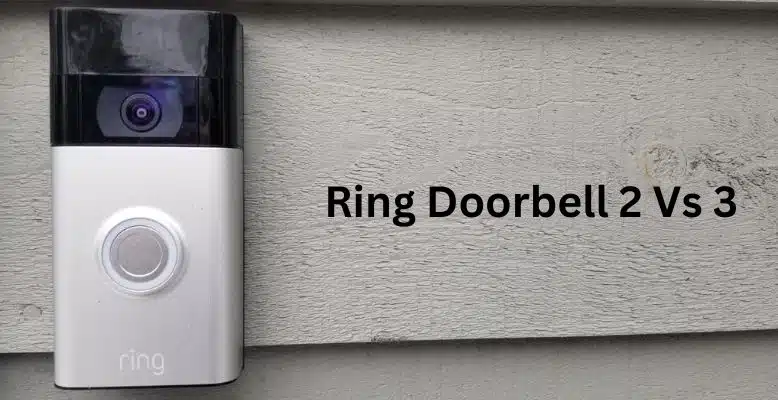
Both the Ring Video Doorbell 2 and Ring Video Doorbell 3 are discontinued. If you found one cheap on eBay or you’re trying to figure out which one you already own, here’s the honest breakdown – and what to actually buy if you’re starting fresh.
Quick Comparison: RD2 vs. RD3
- Resolution: 1080p on both
- Removable battery: Both have it (a common misconception is that only the 3 does – the 2 also has a removable, rechargeable battery pack)
- Wi-Fi: Doorbell 2 is 2.4 GHz only; Doorbell 3 adds 5 GHz dual-band support
- Motion detection: Doorbell 3 adds a “near” motion zone (5-15 ft), which reduces false alerts from traffic
- Pre-Roll: Doorbell 3 only – captures a few seconds of black-and-white video before the motion trigger fires
- Price new: Both discontinued – used market only

What Actually Changed Between the Two
Ring made three real upgrades in the step from the 2 to the 3. The rest is mostly marketing.
Dual-Band Wi-Fi
The Doorbell 2 is 2.4 GHz only. That works fine for most houses, but if your router is on the other side of the wall and your network is crowded with devices, you’ll notice it. The Doorbell 3 can connect to the 5 GHz band if your router supports it – shorter range but less congestion.
In practice, if you have a decent router within 30 feet of your front door, this difference won’t matter. If you’re constantly seeing “poor connection” warnings in the Ring app, the dual-band support in the 3 is worth caring about.
Better Motion Zones
The Doorbell 3 adds a customizable “near” motion zone covering just 5-15 feet in front of the door. This is genuinely useful – it means you can set the doorbell to only alert you when something is actually at your door, not when a car drives past or a squirrel crosses the lawn 20 feet away.
The Doorbell 2 has motion detection too, but the zone customization is cruder. If you’ve been dealing with constant false alerts from the 2, that’s the main reason to consider upgrading. For more on tuning Ring Doorbell 2 motion detection, that guide covers the available options.
Pre-Roll Video
Pre-Roll is a Doorbell 3 exclusive. It buffers a few seconds of black-and-white video before a motion event is detected, so you can see what led up to the trigger – someone approaching the door, a package being left, whatever. It’s a minor but useful feature, especially if you’re reviewing footage after the fact.
The tradeoff is battery life – buffering constantly takes a small but real toll. Per Ring’s own documentation, expect slightly shorter battery intervals when Pre-Roll is enabled. To enable it, go to Device Settings in the Ring app and toggle it on. It should be noted that the Ring Doorbell 2 recording system works slightly differently, without the pre-roll buffer.
What They Share
Both doorbells are more alike than Ring’s marketing implied. The shared specs are worth spelling out so you know what you’re actually working with if you own one:
- 1080p HD video with night vision (infrared, not color)
- Removable, rechargeable battery (5,400 mAh on both) – you pull it out, charge it, put it back. No need to take the whole unit down unless you want to.
- Two-way audio – talking through the Ring Doorbell 2 works the same way on the 3
- Optional hardwired power – both can be wired to an existing doorbell transformer to skip battery charging entirely
- Ring app compatibility, including Alexa integration and the option to add a Ring Chime
- Ring Protect subscription required for video history (recordings delete after 60 days on a plan; no local storage option)
A Note on the Battery Myth
There’s a persistent piece of misinformation online that the Ring Doorbell 2 does NOT have a removable battery – that you have to pull the whole unit off the wall to charge it. That’s wrong. The Doorbell 2 has a removable battery pack, same as the 3. You pull the faceplate off, slide out the battery, charge it on the included cable, and replace it. The guide on removing the Ring Doorbell 2 faceplate walks through it if you’ve never done it.
The original Ring Video Doorbell (1st gen) was the one that required full removal for charging. The 2 fixed that. Worth knowing if you’re considering either model.
How to Tell Which One You Have
If you inherited a Ring doorbell and you’re not sure which generation it is, there are two quick ways to find out.

Should You Upgrade from a 2 to a 3?
Probably not worth it unless you’re getting one for free or nearly free. The Doorbell 3 improves on the 2 in real ways, but none of them are dramatic enough to justify paying used-market prices for a discontinued device when current models exist at similar price points.
If you have a working Doorbell 2 and it’s doing its job, keep it. Ring still supports it with app updates. If you’re on the fence about replacing it, the Doorbell 3 isn’t the answer – see the section below.
What to Buy Instead in 2026
Both the 2 and the 3 are out of production. Ring’s current battery doorbell lineup replaces them with three clear tiers:
- Ring Battery Doorbell Plus (~$150) – 1536p HD+ resolution, head-to-toe field of view (wider vertical FOV so you can actually see packages on the ground), color Pre-Roll, dual-band Wi-Fi. This is the most direct upgrade from either the 2 or the 3.
- Ring Video Doorbell 4 (~$200) – 1080p, color Pre-Roll (the 3 had black-and-white), dual-band Wi-Fi, removable battery. If you want the closest feature set to the Doorbell 3 but with color pre-roll, this is it.
- Ring Video Doorbell (base, ~$100) – 1080p, 2.4 GHz only, removable battery. Essentially what the Doorbell 2 was, but current and supported. Fine if you just need basic doorbell coverage without the extras.
For most people, the Battery Doorbell Plus at $150 is the right answer. The head-to-toe view alone is worth the step up – older models miss packages entirely because the FOV cuts off at knee height.