
This post contains affiliate links. If you buy through them, DumbSwitches may earn a commission at no extra cost to you. See our full disclosure.
The Ring Doorbell 2 was discontinued in 2020, but millions are still installed and working fine – Ring still supports them. If you’ve got one and want to figure out the chime situation, here’s exactly how it works.
The Three Chime Options
There are three distinct ways to get a chime sound with a Ring Doorbell 2. Each works differently and has different requirements.
- Existing in-home chime (mechanical or digital): If you have a wired doorbell setup already, the Ring Doorbell 2 can connect to it. You’ll need the Pro Power Kit V2 (included in the box) and a hardwired installation – battery-only mode won’t drive an in-home chime.
- Ring Chime (3rd Gen): A plug-in Wi-Fi speaker (~$30) that connects wirelessly to your Ring doorbell and plays a chime when someone presses the button. No wiring needed – just plug it into any outlet. Sold separately.
- Ring Chime Pro: Same idea as the standard Chime but also acts as a Wi-Fi range extender for your Ring devices, adds a built-in nightlight, and supports both 2.4 GHz and 5 GHz networks. Worth the upgrade if your router is far from the front door.
- Amazon Echo devices: Any Echo speaker can function as a chime via the Alexa app’s Ring integration. You set it up in Alexa’s device settings and Echo announces visitors out loud – useful if you already own one.
One thing worth clarifying: the Ring Doorbell 2’s built-in speaker is for two-way talk only. It does not play a chime sound on the doorbell itself. The chime options above are all separate from the doorbell unit.
Can the Ring Doorbell 2 Work Without a Chime?
Yes. The doorbell sends push notifications to your phone the moment someone presses the button (or triggers motion detection). If your phone is nearby and notifications are on, a chime is optional.
The main case for adding a chime: you want an audible alert inside the house that doesn’t depend on your phone. Big houses, phones left in another room, family members who aren’t checking the app – a physical chime covers all of that.
How to Connect a Ring Chime to the Ring Doorbell 2
Setup takes about two minutes in the Ring app:
Plug the Ring Chime into a wall outlet
Choose a location you’ll actually hear from the rooms you spend time in. Within 30 feet of your Wi-Fi router is ideal.
Open the Ring app and tap the plus icon to Add a Device
Select Chimes from the device list.
Follow the in-app pairing instructions
The app will walk you through connecting the Chime to your Wi-Fi network. The Chime will enter pairing mode automatically when first powered on.
Link the Chime to your Ring Doorbell 2
Once the Chime is set up, go to its Device Settings in the app and select Linked Doorbells. Select your Ring Doorbell 2 from the list.
Choose your chime tone and set the volume
Both can be adjusted at any time under Device Settings > Chime Tones.
How to Connect to Your Existing In-Home Chime
If you want to keep using the chime already wired into your house, this is possible – but requires a hardwired installation. Battery-only mode won’t power an in-home chime.
The Pro Power Kit V2 is included in the Ring Doorbell 2 box. It wires into your existing chime unit – there are two modes: one that keeps the existing chime active, and a bypass mode that silences it and routes notifications to the Ring app only. Ring has a compatibility checker at ring.com/chime-compatibility – some older mechanical chimes need the bypass approach rather than in-line connection.
How to Change the Chime Tone
If you’re using a Ring Chime or Chime Pro, you can change tones from the app:
- Open the Ring app and tap the three lines (menu) in the top left.
- Tap Devices and select your Ring Chime.
- Go to Device Settings > Chime Tones.
- Pick a tone from the list and adjust volume. Tap Save.
For an in-home mechanical chime, the tone is determined by the chime hardware itself – not changeable via the app. Digital in-home chimes sometimes have a button or switch on the unit to cycle through tones.
How to Disable a Chime
To silence a Ring Chime without unplugging it:
- Open the Ring app and go to Devices.
- Select the Ring Chime you want to silence.
- Tap Device Settings > Chime Tones.
- Set the chime tone to None (or use the Do Not Disturb schedule to mute it during certain hours).
Disabling the chime this way does not affect the doorbell itself – motion alerts and push notifications continue working normally.
Does Using a Chime Affect Battery Life?
No. The Ring Chime and Ring Chime Pro are mains-powered (they plug into a wall outlet) – they don’t draw from the doorbell’s battery at all. Using one has zero impact on how long the doorbell battery lasts.
Battery life on the Ring Doorbell 2 depends almost entirely on how often the doorbell is triggered – high-traffic locations can drain a charge in a few months, quieter installations can go up to a year. If you want to keep the battery charge up and also have a reliable in-home chime, the wired installation option is worth considering since it keeps the battery topped up continuously.
Troubleshooting: In-Home Chime Not Working
If you’ve wired in the Pro Power Kit V2 and the chime isn’t ringing, work through this checklist:
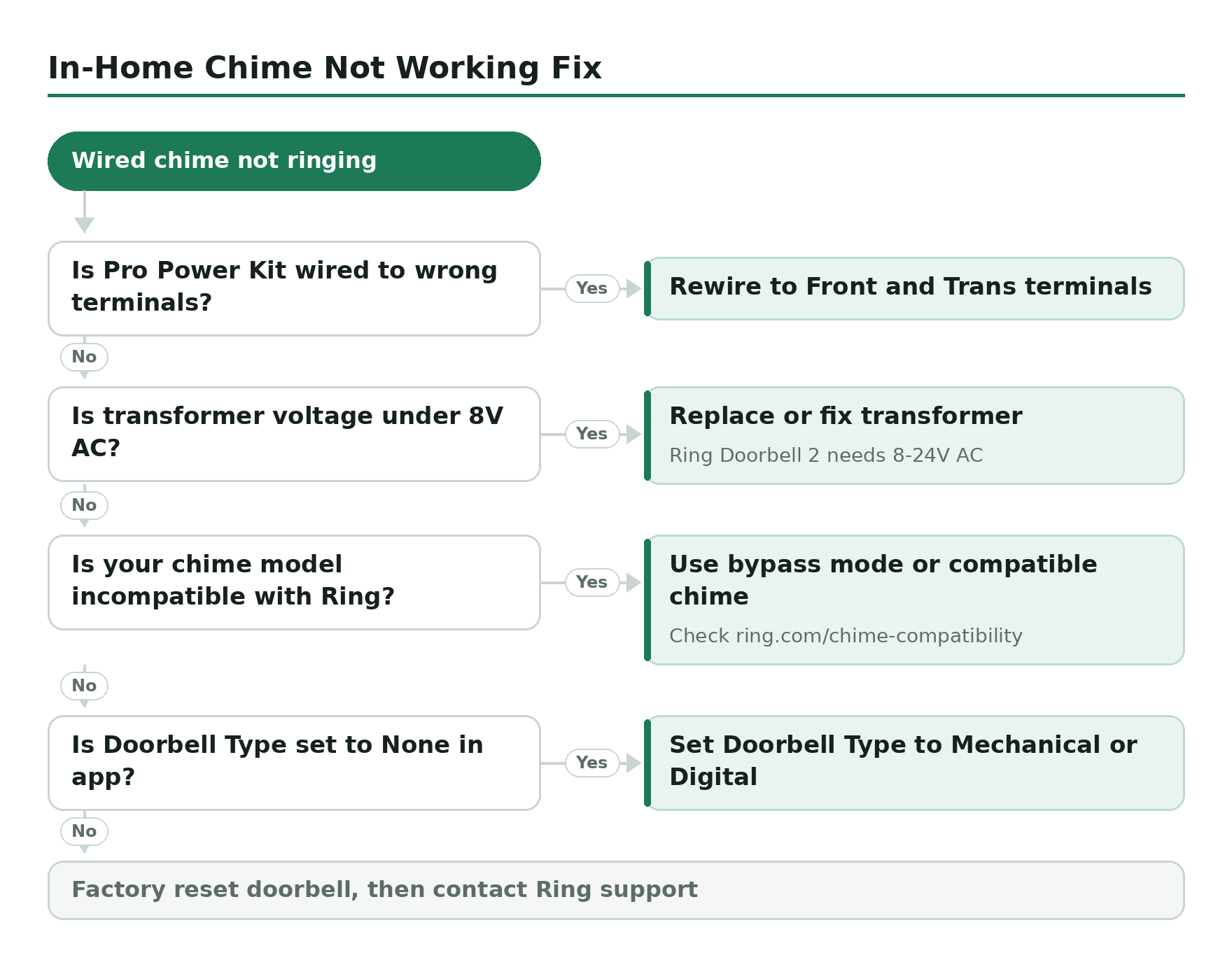
- Check the wiring: Confirm the Pro Power Kit V2 is wired to the correct terminals (Front and Trans). Loose or swapped connections are the most common cause.
- Check the transformer voltage: The Ring Doorbell 2 needs 8-24V AC. Test with a multimeter at the transformer terminals. Anything under 8V and the chime won’t fire. See our guide on transformer requirements if you’re not sure what you have.
- Verify chime compatibility: Some digital chimes are not compatible with Ring. Check ring.com/chime-compatibility.
- Check the In-Home Chime setting in the app: Go to Device Settings for the Ring Doorbell 2 and confirm the Doorbell Type is set to Mechanical or Digital (not None).
- Reset the doorbell: If everything else checks out, press and hold the orange button on the back of the doorbell for 30 seconds to factory reset it, then re-add it to the Ring app.
- Contact Ring support: Ring continues to support the Doorbell 2 despite its discontinuation. Their support team can remotely diagnose connection issues.
Which Chime Option Is Right for You?
Quick answer:
- Already have a wired doorbell chime: Use the Pro Power Kit V2 (in the box) and wire the Ring Doorbell 2 in. No extra purchase needed.
- No existing chime wiring, want something simple: Get the Ring Chime (3rd Gen). Plug it in, pair it in the app, done.
- Router is far from the front door and Ring connectivity is spotty: The Ring Chime Pro doubles as a Wi-Fi extender, which can help with connection stability.
- Already own Amazon Echo devices: Skip the dedicated Chime and use Alexa as your announcement system instead. Set it up in the Alexa app under Devices.
Also worth knowing: since the Ring Doorbell 2 is discontinued, Ring no longer sells it directly. The current equivalent is the Ring Battery Doorbell Plus, which has better video resolution (1536p vs 1080p), improved motion detection, and a wider field of view. All the chime options above work with it as well.
For more on the Ring Doorbell 2’s capabilities, see our guides on night vision performance, two-way audio, and hardwired installation.