
This post contains affiliate links. If you buy through them, DumbSwitches may earn a commission at no extra cost to you. See our full disclosure.
Short answer: yes, two Ring doorbells can share one transformer – but only if the transformer is actually up to the job. Most houses have a doorbell transformer rated at 8-10VA, which can’t reliably power even one Ring doorbell. For two, you need a minimum 16VAC/30VA unit, and 24VAC/40VA is the smarter spec if you want headroom.
Here’s the full breakdown – what Ring actually requires, why your existing transformer is probably the weak link, and how to wire two doorbells correctly when you’re ready to do it.
What Does a Doorbell Transformer Actually Do?
Your doorbell runs on low-voltage AC power – not the 120V that comes out of your wall outlets. The transformer sits in-line (usually mounted in your electrical panel, near the chime, or in a junction box) and steps that 120V down to the 16-24V your doorbell needs. That’s it. It’s not complicated hardware, but the VA rating matters enormously for video doorbells.
VA (volt-amps) is essentially the power capacity. An old mechanical doorbell might run fine on 8VA. A Ring Video Doorbell Pro 2 processing 1080p video, running motion detection, and maintaining a WiFi connection is a different animal entirely.
Ring’s Transformer Requirements by Model
Ring publishes specific requirements per model type, and they’re different enough to matter:
- Battery-powered Ring doorbells (including the Ring Battery Doorbell Plus): 8-24VAC, 5-40VA. Hardwiring on these models provides a trickle charge to keep the battery topped up – it’s not the primary power source. The low floor (8V, 5VA) means even a weak old transformer can handle the wiring connection.
- Ring Video Doorbell Wired: 10-24VAC, 8-40VA minimum.
- Ring Wired Doorbell Pro / Pro 2 / Wired Doorbell Plus: 16-24VAC, 10-40VA minimum. These are the power-hungry ones – they draw directly from the transformer with no battery buffer.
Per Ring’s own support documentation, the maximum VA for any Ring doorbell is 40VA. Going above that won’t help and could cause issues.
Can One Transformer Power Two Ring Doorbells?
Yes – Ring has confirmed this officially. A Ring support team member stated in the Ring community that “a 16VAC 30VA transformer should provide enough power for two Doorbell Pros.” Ring also publishes wiring diagrams showing two Wired Doorbell Plus or Pro units connected to a single transformer through a single chime.
That said, “technically possible” and “works reliably long-term” are two different things. The caveats:
- A 16V/30VA transformer at the limit with two Pro-class doorbells leaves zero headroom. Add a long wire run or a cold day and you’ll get low-power warnings or random reboots.
- Ring does NOT officially support two Ring Video Doorbell Wired units sharing a single transformer – the wiring setup for that specific model conflicts with the hardware requirements.
- Battery-model doorbells wired in parallel are more forgiving because the battery handles peak demand. But you still need a transformer that can sustain the combined trickle charge draw.
- Your house transformer is almost certainly 8-10VA. That’s enough for a mechanical doorbell chime. It will fail to charge even one hardwired Ring doorbell reliably.
The Right Transformer for Two Ring Doorbells
If you’re wiring two Pro-class doorbells, go with a 24VAC/40VA transformer. The higher voltage handles longer wire runs better (less voltage drop), and the 40VA gives you genuine headroom instead of running at capacity.
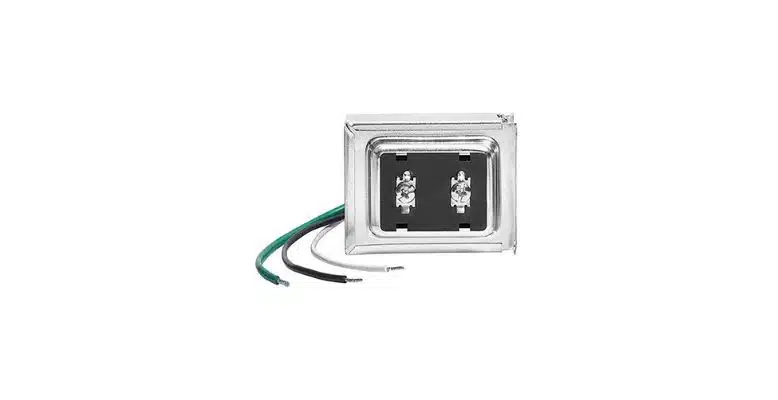
The Newhouse Hardware 24V 40VA transformer is a well-established option – UL listed, wired install, compatible with Ring/Nest/Honeywell. For a drop-in Ring-branded option, the Ring Hardwired Transformer runs 16V/30VA – fine for a single doorbell or two battery-model units, tighter for two Pro-class devices.
For two battery Ring doorbells (where wiring = charging, not primary power), 16V/30VA works. For two fully-wired Pro or Pro 2 units, use 24V/40VA.
A Note on the Ring Doorbell 2
The Ring Video Doorbell 2 has been discontinued. Ring replaced it with the Ring Battery Doorbell Plus – same removable battery design, improved head-to-toe video, longer battery life. If you’re shopping now, skip the Doorbell 2 and get the current generation.
The Doorbell 2 (and its successor) is a battery model that can be hardwired for trickle charging. Two of them on one transformer is straightforward because neither draws heavily from the transformer for primary power.
How to Install Two Ring Doorbells on One Transformer
Before you start: confirm your transformer is rated for the job (see above), and check that your chime unit has separate terminals for front and rear doorbells – most modern chimes do.
Verify or upgrade your transformer
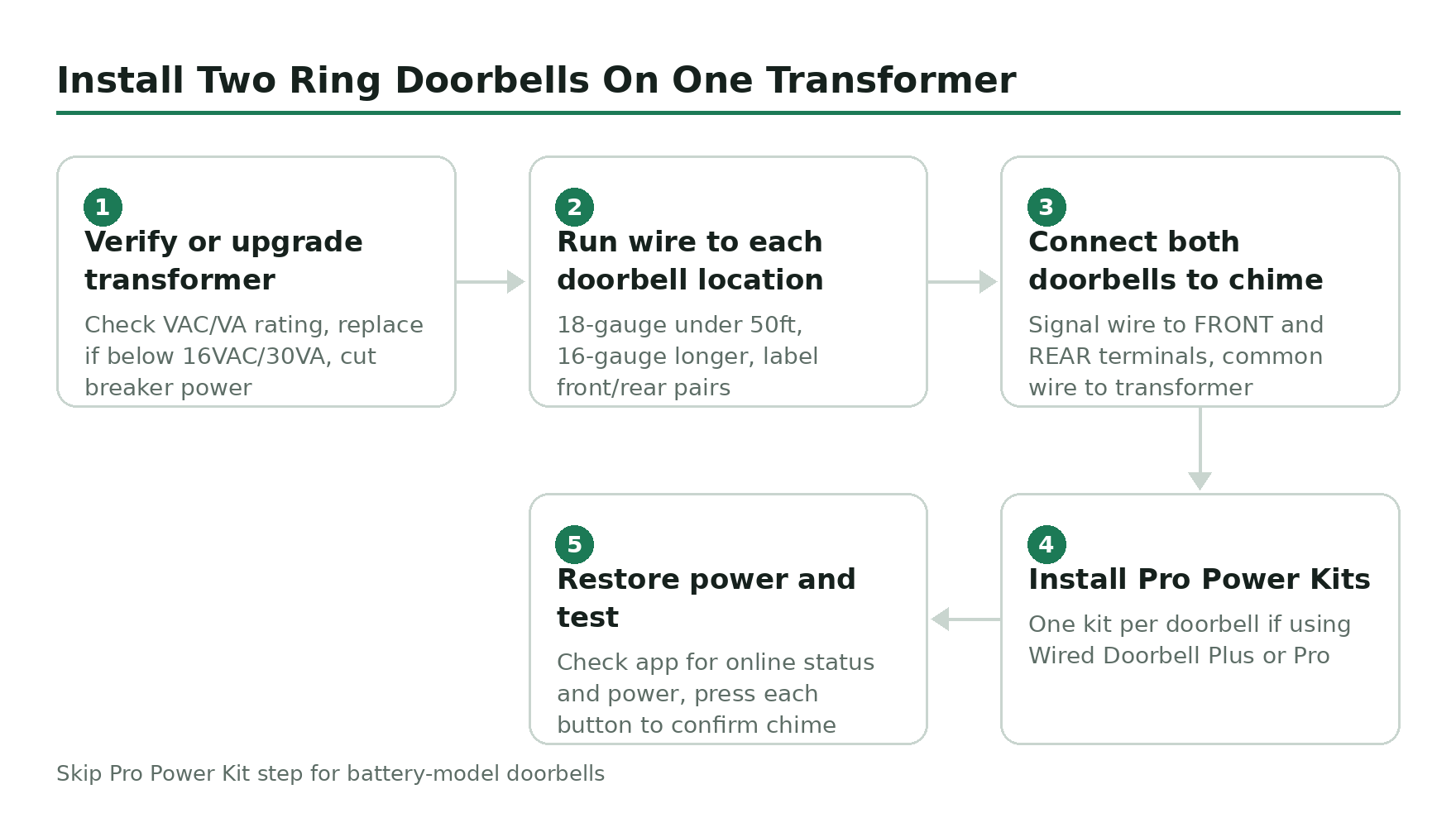
Check your existing transformer for its VAC and VA rating (printed on the label). If it’s below 16VAC/30VA, replace it before doing anything else. For two Pro-class doorbells, install a 24VAC/40VA transformer. Turn off power at the breaker before handling the transformer.
Run wire from the transformer to each doorbell location
Each doorbell needs its own two-wire run back to the transformer (or chime). Use 18-gauge wire for runs under 50 feet. For longer runs, use 16-gauge to reduce voltage drop. Label each wire pair by location (front/rear) before routing.
Connect both doorbells to the chime unit
At your chime, connect each doorbell’s signal wire to its own terminal – FRONT for the primary entrance, REAR (or SIDE) for the secondary. The common wire from each doorbell connects back to the transformer. Ring publishes wiring diagrams for this specific setup on their support site.
Install Pro Power Kits if using Wired Doorbell Plus or Pro models
Ring Wired Doorbell Plus and Pro models ship with a Pro Power Kit – a small bypass device that installs inside your chime to ensure consistent power delivery. With two doorbells, you need one Pro Power Kit per doorbell. Follow the included instructions to install both before powering on.
Restore power and test both doorbells
Turn the breaker back on. Open the Ring app and verify both devices show online and report good power status. Press each doorbell button and confirm the chime fires for the correct unit. If either doorbell shows low-power warnings, the transformer may still be undersized for your specific wire run length.
Tips to Make It Work Reliably
- Oversize the transformer by design. A 40VA transformer running two doorbells at ~60% load will outlast a 30VA unit running at 100%. The math is simple and the cost difference is about $5.
- Keep wire runs short where possible. Every extra foot of wire causes voltage drop. If one doorbell is 80 feet from the transformer and the other is 10 feet, the far one will have noticeably lower voltage – enough to cause trouble on a weaker transformer.
- Check the Ring app’s device health after installation. Each Ring device reports its current power status. A reading below 3800mV in the app means the doorbell is underpowered and you need to look at the transformer or wire gauge.
- When in doubt, use separate transformers. Two transformers – one per doorbell – eliminates power sharing entirely. It’s more work to install but solves every potential load issue permanently. A 16V/30VA transformer per unit runs about $15-20 each.
Related Guides
If you’re setting up Ring doorbells, these might help: