

This post contains affiliate links. If you buy through them, DumbSwitches may earn a commission at no extra cost to you. See our full disclosure.
Yes, Arlo cameras work with Apple HomeKit – but there’s a distinction worth knowing up front. Arlo supports HomeKit (live view, motion alerts, Siri control, Apple Home app), but does not support HomeKit Secure Video, which is the Apple feature that stores encrypted recordings to iCloud. If you’re buying Arlo expecting iCloud-stored clips, that’s not what you’re getting. If you just want your cameras in the Apple Home app with full smart home automation, Arlo delivers.

You also need an Arlo SmartHub regardless of which camera you buy. There’s no direct-to-WiFi HomeKit path – the SmartHub is the HomeKit bridge. Plan for that cost if you don’t already own one.
Which Arlo Cameras Support HomeKit
Arlo’s official HomeKit-compatible lineup as of 2026 includes:
- Arlo Pro Security Camera (6th Gen, 2025) – 2K HDR, dual-band WiFi, outdoor/indoor, current flagship
- Arlo Ultra Security Camera (3rd Gen) – 4K HDR, color night vision, outdoor
- Arlo Pro 5S 2K – solid mid-range option, widely available
- Arlo Pro 4 Spotlight Camera – 2K HDR, still available and popular
- Arlo Pro 3 Floodlight Camera – 2K with integrated floodlight
- Arlo Essential Security Camera (3rd Gen) – 2K, budget-friendly entry point
- Arlo Essential Indoor Security Camera (3rd Gen) – indoor monitoring
- Arlo Essential 2K Video Doorbell, 2K Indoor Camera, and 2K Outdoor XL Camera (2nd Gen) – added Apple Home support in April 2025
- Arlo Video Doorbell – wired, 180-degree view
All of these require a SmartHub or compatible Base Station connected via Ethernet to your router. None of them will appear in Apple Home if they’re running in direct-WiFi mode – that includes the newer 2nd-gen Essential models, which some coverage implied might be hub-free. They aren’t.
The Arlo Pro 6th Gen is the best current buy – it ships with a SmartHub in the bundle packs, handles both 2.4 GHz and 5 GHz WiFi, and has the best firmware support track record for HomeKit reliability.
Hub or No Hub?
Hub required. Full stop.
Most Arlo cameras can connect directly to your WiFi without a SmartHub for standard Arlo app use – but HomeKit integration specifically needs the SmartHub in the loop. Arlo’s HomeKit pairing process scans a code on the SmartHub, not the camera. The cameras then appear as accessories through it.
The Arlo SmartHub (VMB5000) connects via Ethernet cable to your router. It supports up to six cameras and provides local backup storage via USB. If you’re already running Arlo cameras without one, you’ll need to add it before HomeKit will work.
One exception worth knowing: the Arlo Baby Monitor supports HomeKit without a SmartHub. That’s the only outlier in the lineup.
HomeKit Setup with Arlo – Step by Step
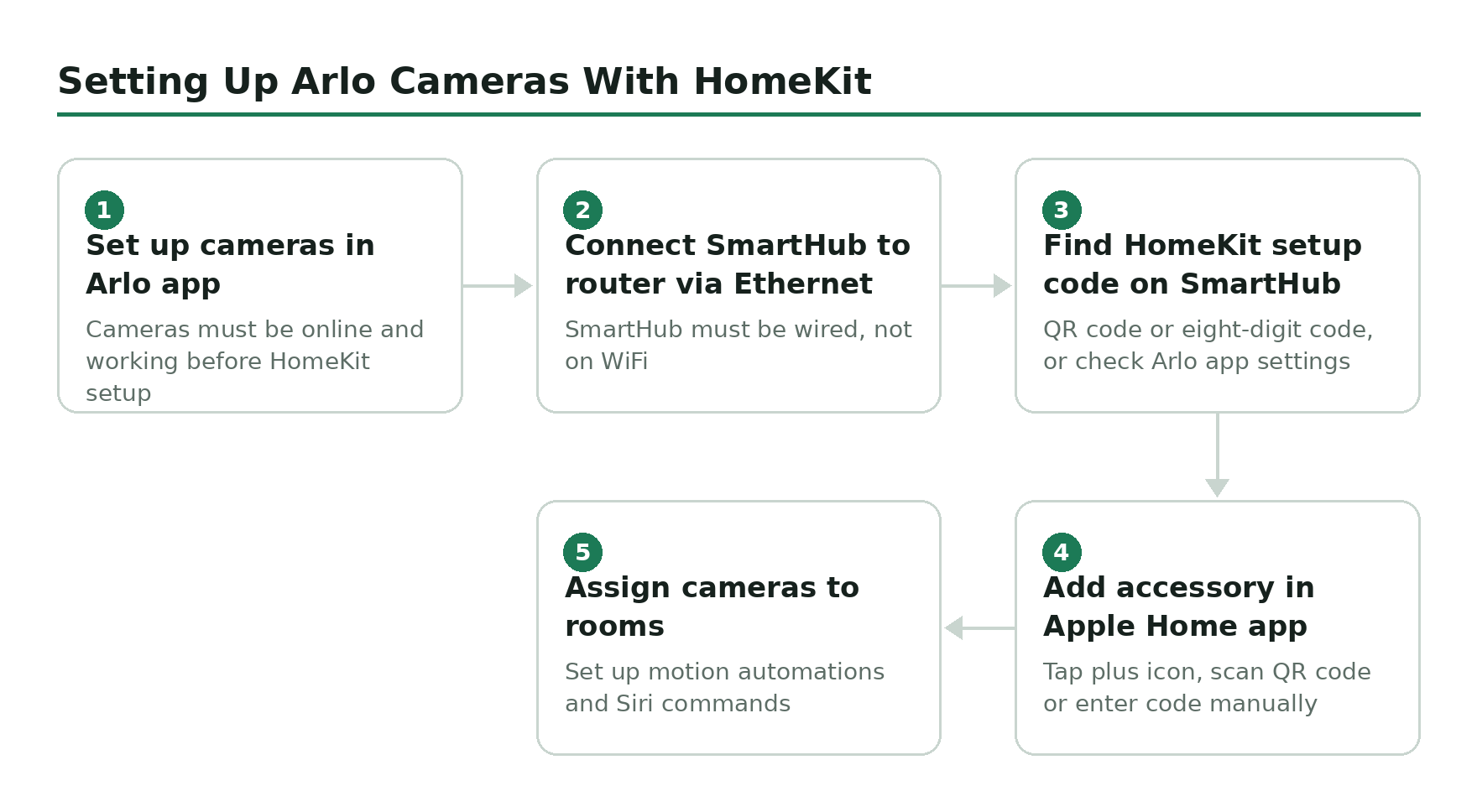
How to add Arlo cameras to Apple Home using the Arlo SmartHub.
Set up your Arlo cameras in the Arlo app first
Install and configure your cameras using the Arlo app before touching HomeKit. They need to be online and reporting correctly. Don’t skip this step – HomeKit setup will fail if the cameras aren’t already working in the Arlo ecosystem.
Connect your Arlo SmartHub to your router via Ethernet
The SmartHub must be wired to your router, not on WiFi. Once connected and powered, it should appear as online in the Arlo app. If it shows offline, check the Ethernet cable and restart both devices.
Find the HomeKit setup code on your SmartHub
Look on the bottom or back of your SmartHub for the HomeKit QR code or eight-digit setup code. You can also find it in the Arlo app under Settings > My Devices > SmartHub > HomeKit.
Open the Apple Home app and add an accessory
Tap the + icon in the top right corner of the Apple Home app, then tap ‘Add Accessory’. Scan the QR code on the SmartHub or enter the eight-digit code manually.
Assign cameras to rooms and configure automations
Once the SmartHub is added, your connected Arlo cameras appear as accessories in Apple Home. Assign each to a room, set up motion automations, and configure Siri commands. You can now view live feeds and receive motion alerts directly through the Home app.
What You Give Up Without HomeKit Secure Video
This is the actual decision point, and it’s worth spelling out. HomeKit Secure Video is Apple’s own recording layer: footage is analyzed on your home hub, encrypted, and stored in your iCloud+ plan – not on the camera maker’s servers, and not counted against your regular iCloud photo storage. A single iCloud+ tier covers every HKSV camera in your house, no matter the brand.
Arlo doesn’t plug into that system. Here’s what that actually means day to day:
- No iCloud recording. Footage that gets recorded goes to Arlo’s own cloud, not Apple’s. It never shows up alongside your other HKSV cameras in one unified storage plan.
- Recording isn’t free. A native HKSV camera records to iCloud with no camera-specific subscription. Arlo requires its own Arlo Secure plan to store anything longer than a live glance – see pricing below.
- No end-to-end encryption guarantee the way HKSV provides it. Apple’s implementation encrypts clips such that even Apple can’t view them. Arlo’s cloud storage runs on Arlo’s own security model, not Apple’s.
- Activity zones and face recognition stay in Arlo’s app, not Apple’s. HKSV cameras get Apple’s on-device face recognition and activity-zone tools built into the Home app itself. Arlo’s version of those features lives in the Arlo app, separate from HomeKit.
What you do still get through HomeKit, subscription or not: live view, motion push notifications, two-way audio, Siri commands, and inclusion in HomeKit automations (“turn on the porch light when the front camera detects motion” works fine). For a lot of people that’s enough. If recorded history matters and you want it inside Apple’s ecosystem specifically, no Arlo camera on the market gets you there – see the full list of cameras that do support HKSV if that’s the priority.
Subscription Requirements for HomeKit Storage
Here’s where it gets blunt: Arlo does not support HomeKit Secure Video. That means your recordings don’t go to iCloud. They go to Arlo’s cloud – which requires an Arlo Secure subscription.
Current Arlo plans (2026):
- Arlo Secure Plus (single camera) – $7.99/month, 60 days cloud storage
- Arlo Secure Plus (unlimited cameras) – $17.99/month, 60 days cloud storage
- Arlo Secure Premium – adds 24/7 professional monitoring with emergency dispatch
Without a subscription, newer Arlo cameras don’t record or store clips at all – they only do live view. The free tier that older models used to get is gone on current hardware.
For HomeKit-only users: your Apple Home app gives you live view, motion notifications, and Siri control with no Arlo subscription required. But if you want recorded footage to review later, you need an Arlo plan or the SmartHub’s USB local storage option.