
This post contains affiliate links. If you buy through them, DumbSwitches may earn a commission at no extra cost to you. See our full disclosure.
Govee TV backlights use a camera-based calibration system that maps your TV’s edges and tells the lights exactly where colors should appear. If calibration is off, you get a backlight that flickers the wrong hues or drops segments entirely. Here is exactly how to fix it.

Quick note on models: the original Govee DreamView T1 (H6199/H6198) uses a single camera. The current model is the Govee Envisual TV Backlight T2 – dual cameras, denser LED beads, 40% more accurate color capture. The calibration flow is nearly identical for both, and the steps below cover it. If you are on the T1, ignore any reference to two camera feeds in the app.
Why Calibration Matters
The camera does not magically know where your TV screen ends. Calibration is the process of telling it – you place foam markers at seven specific points on the screen, open the app, and drag digital pins to match those physical markers. The device then knows the exact boundaries and corner positions of your display.
Skip it or do it sloppily and the backlight will bleed the wrong colors to the wrong strip segments. Colors that should only appear on the left side will bleed right, or the top strip will react to what is happening at the bottom of the screen. It looks bad. Calibrate properly and the whole thing clicks into place.
What You Need Before You Start
- Your Govee DreamView T1 or Envisual T2 fully installed and connected to Wi-Fi
- The Govee Home app installed on your phone (formerly called “Govee” – same app, rebranded)
- The seven orange foam sticker squares included in the box
- A room with low ambient light – direct sunlight or bright overhead lighting will interfere with the camera during calibration
If you have not done the physical installation yet, start there first. Here is the installation guide and the initial setup walkthrough.
How to Calibrate the Govee DreamView / Envisual T2
The process takes about five minutes once everything is installed. Do it with your TV on and displaying a neutral image – the calibration screen will appear inside the app automatically.
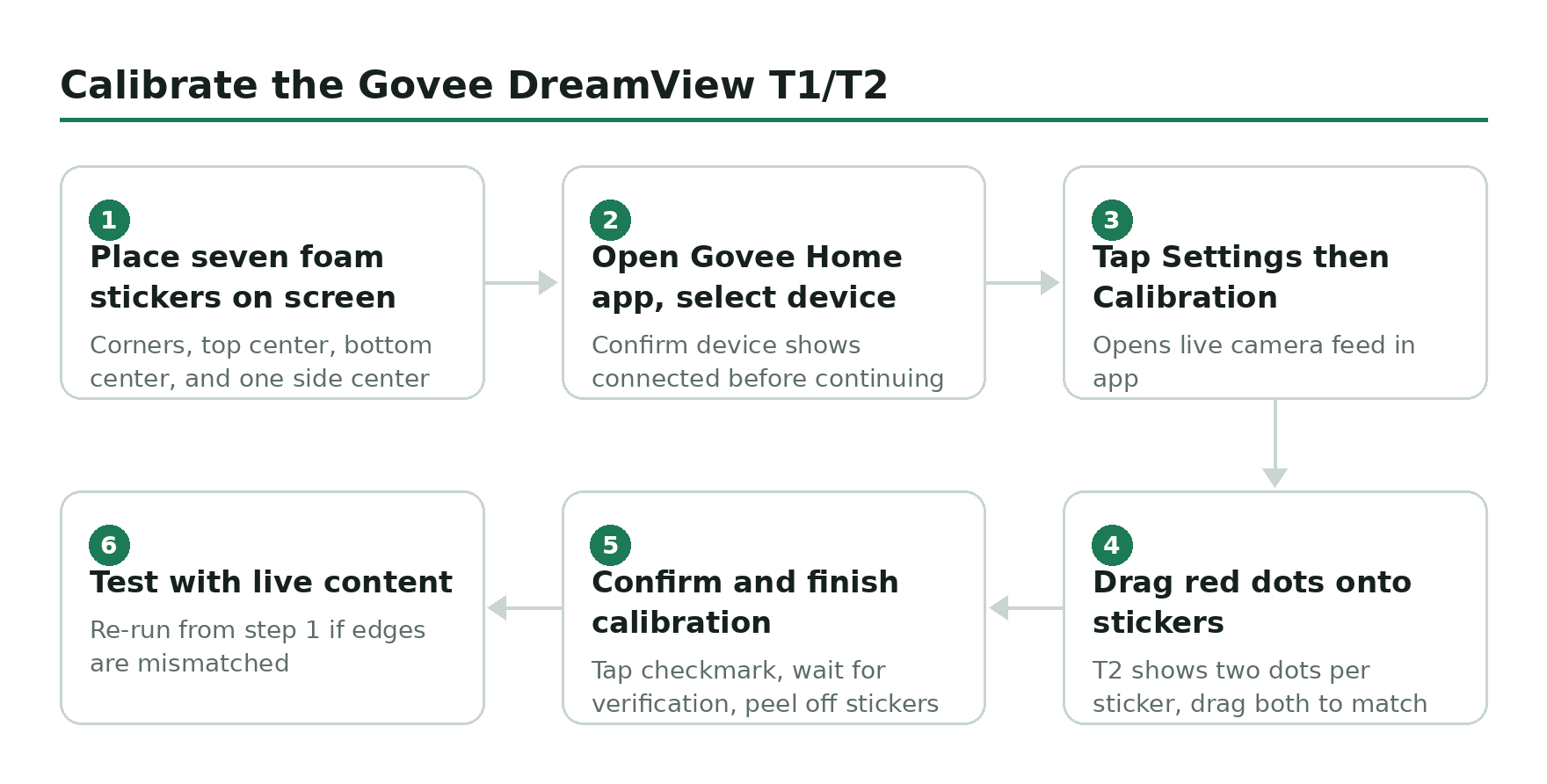
Place the seven orange foam stickers on your TV screen
Stick one at each corner of the TV screen, one at the center of the top edge, one at the center of the bottom edge, and one at the center of the left or right side. Press lightly – do not push the stickers into the screen. They are just visual reference points for the camera.
Open Govee Home app and navigate to your device
Tap your DreamView T1 or Envisual T2 in the device list. Make sure the device shows as connected – calibration requires an active Wi-Fi link. If you see it offline, restart the device and wait 30 seconds.
Go to Settings and tap Calibration
Inside the device page, tap the settings icon (top right corner). Scroll down to find the Calibration option and tap it. The app will display the live camera feed from your device.
Drag the digital calibration points to match the foam stickers
The app shows your TV via the camera with seven draggable red dots overlaid. Drag each dot to the corresponding orange foam sticker on screen. On the T2 with dual cameras, each sticker appears as two overlapping red points – one per camera. Drag both to the same sticker position. Calibration lines must not cross each other.
Confirm and let the calibration process finish
Tap the confirm or checkmark button once all points are positioned correctly. The app runs a quick verification pass. When complete, it returns you to the device main screen. Peel the foam stickers off the TV.
Test with live content and fine-tune if needed
Play a video with a mix of colors and watch the backlight response. If specific edges are mismatched, re-run calibration from step 1. You can also adjust saturation and white balance inside the Govee Home app under device settings without recalibrating.
Calibration Not Working – Troubleshooting
Most calibration failures come down to three things: lighting, Wi-Fi, or crossed calibration lines. Work through these in order.
Colors Do Not Match the Screen
This is almost always a calibration point placement problem. The camera calculated the wrong screen boundaries, so it is mapping light zones to the wrong areas of the display.
- Re-run calibration with the room darkened. Close blinds and turn off overhead lights. Ambient light that falls directly on the screen or the camera lens throws off the color detection.
- Check calibration line geometry. In the app’s calibration view, the lines connecting your seven points should form a clean rectangle-ish shape. If any lines cross, the camera will map edges to wrong positions.
- Adjust saturation and white balance in Govee Home app settings before committing to a full re-calibration. Sometimes the calibration is fine but the color output just needs tuning.
Calibration Fails or App Gets Stuck
- Weak Wi-Fi signal during calibration causes the camera feed to drop or fail to upload. Move your phone closer to the router or temporarily use a phone hotspot during the calibration step only.
- Device shows offline in app: power cycle the Govee controller, wait 30 seconds, reconnect in-app before starting calibration.
- Camera angle on the T2: the dual-camera unit mounts at the top-center of the TV using a counterweight system. If it is tilted significantly or the cameras are not pointing directly at the screen, the live feed will be distorted and calibration will fail or produce bad results.
Specific Segments Not Responding
If one side of the backlight is dead or not syncing while others are, this is usually a hardware connection issue rather than calibration. Check the LED strip connectors at each corner – loose connections are common after installation. If the connector is secure and the segment is still dark, contact Govee support (it may be a defective strip section).
T1 vs T2 – Does the Calibration Process Differ?
For the most part, no. Both models use seven foam stickers, the same Govee Home app, and the same drag-to-match calibration interface. The meaningful difference is this:
- The T1 has a single camera mounted at top-center. Each calibration point is one red dot in the app.
- The T2 has dual cameras. Each foam sticker appears as two overlapping red dots – one per camera view. You need to position both correctly. Do not just drop one and move on.
The T2’s dual camera setup is why it captures colors 40% more accurately than the T1 – it has twice the viewing angle data to work with. If you are upgrading from T1 to T2, the Govee Envisual T2 (55-65″) and the larger 75-85″ version are both currently available on Amazon.