

Two wires, a switch, and a blank spot where the instructions say a third wire should be. That’s the moment a smart switch install turns into a research project. The short answer: no-neutral switches exist, they mostly work, and there’s an actual electrical code behind why your box looks the way it does.
Why a Neutral Wire Matters to a Smart Switch
A dumb switch is a mechanical gate. Power flows to the load when the gate is closed and stops when it’s open – the switch itself needs nothing to operate.
A smart switch is a small computer wearing a switch costume. It needs continuous, low-level power to run its Wi-Fi or Zigbee radio, hold its network connection, and respond the instant an app or voice command tells it to flip. That standby power has to come from somewhere even while the light is off, and the neutral wire is the normal path: it completes the circuit back to the panel so the switch can draw a trickle of current without sending it through the bulb.
Without a neutral in the box, a switch has two options. It can borrow power by trickling a small current through the light fixture itself and back through the fixture’s own neutral – the “phantom load” approach used by most no-neutral switches. Or the load can be moved off the switch entirely, with a bypass device installed at the fixture, or by skipping the switch’s smarts and putting them in the bulb instead. Both workarounds exist because so much US housing stock predates the wiring habits that make a neutral wire a given.
What the Electrical Code Actually Says
This is the part almost nobody selling you a switch bothers to explain, and it’s the reason no-neutral hardware exists in its current form.
The National Electrical Code (NEC) is revised on a three-year cycle, and states and cities adopt a given cycle on their own schedule – some move fast, some are still enforcing a version from a decade ago. Nothing below is a claim about what your local inspector will accept. Check your jurisdiction’s adopted cycle before treating any of this as current where you live.
404.2(C): the neutral-at-switch rule narrowed in 2017
NEC section 404.2(C) is the rule that decides whether a neutral conductor has to be run to a switch location in new construction or a rewire. In the 2014 cycle, the rule listed seven situations where a neutral didn’t have to be present at the switch. The 2017 cycle cut that list to five, and changed a single word that matters: the neutral used to have to be “provided” at the location, and the 2017 language requires it to be “installed.” That’s a tighter standard – provided allows for a neutral that’s nearby and accessible; installed means it has to actually be run to the box.
The five exceptions that survived into the 2017 text: a raceway is present that could carry a neutral later, the box is accessible without removing finish material, the switch is an integral-enclosure snap switch covered under 300.15(E), the switch is part of an automatic lighting control system, or the switch’s load is a receptacle, not a light fixture. Outside those five cases, a 2017-cycle jurisdiction requires a neutral at the switch location, full stop.
None of this touches existing wiring. A house built to the 2011 or 2014 code isn’t retroactively out of compliance, and nobody has to rewire a working switch box because a later cycle changed the rule for new work. If your box has two wires and nothing else, it’s very likely built entirely to code, under a code from before this requirement existed or tightened.
The January 2020 rule that reshaped the no-neutral switch market
The bigger change for smart switches didn’t come from the neutral rule at all. As of January 1, 2020, electronic lighting-control switches are barred from putting current on the equipment-grounding conductor during normal operation, with narrow exceptions. That targets exactly the trick a lot of early no-neutral switches used: routing standby trickle current through the ground wire instead of a neutral, since the ground wire was usually present even when the neutral wasn’t. The 2020 rule closed that path.
It’s why the no-neutral switches sold today mostly work by trickling current through the load and fixture instead – the ground-wire method they might once have used is no longer allowed. It’s also why the switches on shelves now are meaningfully different hardware than what was on shelves a decade ago, even where the marketing copy still just says “no neutral required.”
Layered into the same rule change: legacy replacement and retrofit switches that do put current on the equipment-grounding conductor are capped at five units per branch circuit or twenty-five per feeder. That’s a ceiling on how many of the older-style devices can share a circuit or feeder, not a rule that applies to modern trickle-through-the-load switches.
Source for both NEC items: the Independent Electrical Contractors Association’s summary of the 2017 NEC cycle changes to Chapter 4, which reproduces the operative 404.2(C) text, the full five-exception list, and the January 2020 amendment language directly.
Figuring Out What You Actually Have
Before buying anything, you need to know what’s in the box. This is a look-and-count job, not a wiring job: kill the breaker for that circuit, then confirm it’s actually dead with a non-contact voltage tester or multimeter before you touch anything. Don’t trust the breaker label – test it.
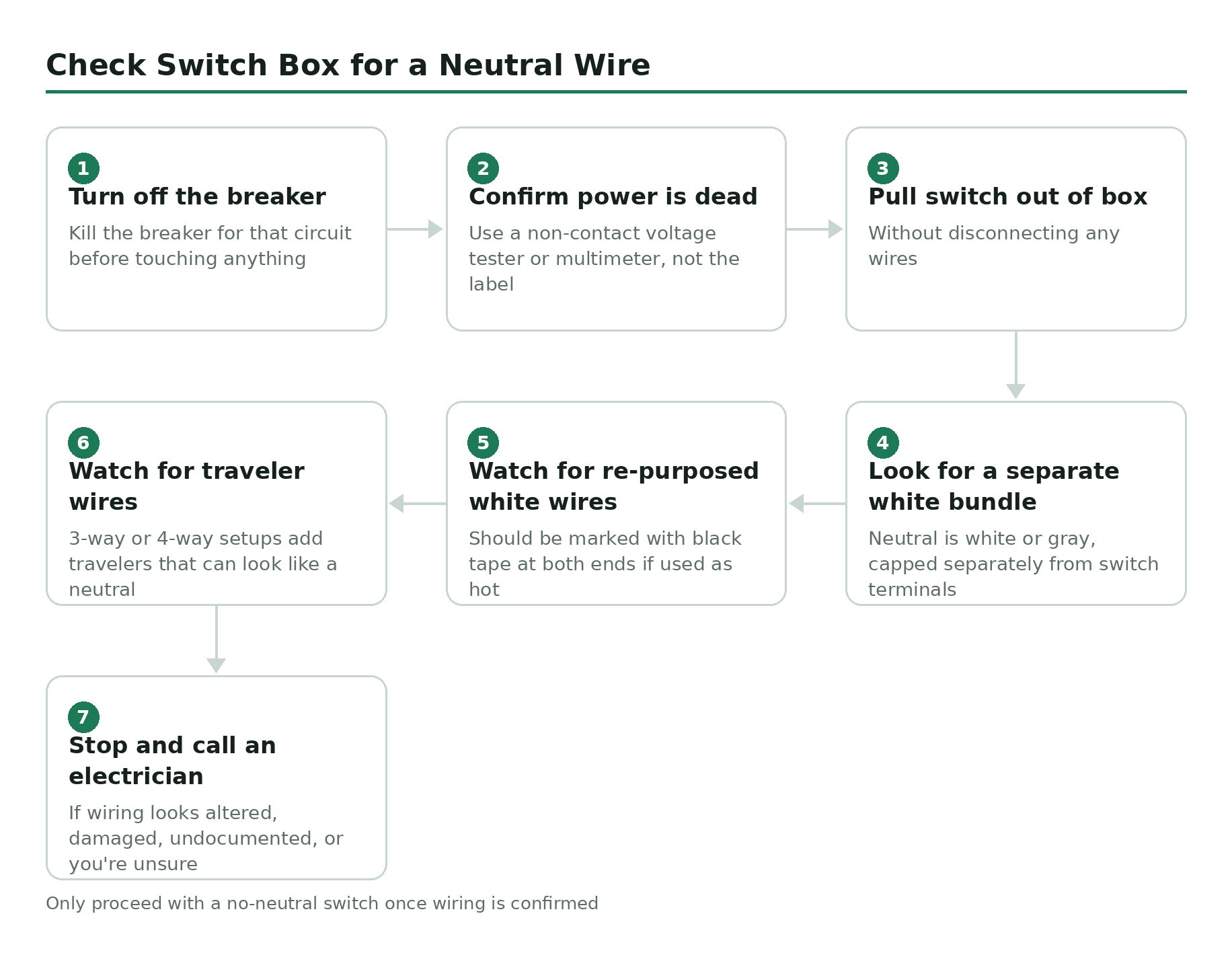
With the power confirmed off, pull the switch far enough out of the box to see the wire count without disconnecting anything. A neutral is typically white or gray, and where one exists you’ll usually see a bundle of white wires capped together separate from the switch’s own terminals – the switch doesn’t use the neutral, but it passes through the box on its way to the fixture. Only black (hot) wires and one going to the fixture, with nothing white bundled off to the side, means you’re very likely looking at a no-neutral box.
Two things complicate this. Some older wiring uses non-standard colors, or a white wire has been re-purposed as a hot leg and should be marked with black tape at both ends (and often isn’t). And a 3-way or 4-way setup – where two or more switches control one fixture – adds traveler wires that can look like a neutral to an untrained eye but aren’t; our Leviton Decora Smart review covers what a 3-way conversion actually involves once you know what you’re wiring to. If you open the box and you’re not confident you can identify every wire correctly, or the wiring looks altered, damaged, or undocumented, stop and call an electrician.
This guide isn’t going to walk through connecting wires – that depends on your specific switch, box, and local code. If there’s any doubt, the right next step is a licensed electrician, not a YouTube video.
What Actually Works Without a Neutral
Assuming a no-neutral box is confirmed, here’s what’s actually available, verified against each manufacturer’s own documentation.
Lutron Caseta – the reference case, if you get the right model
Lutron’s Caseta line runs on Clear Connect, a proprietary RF mesh that operates independently of Wi-Fi and doesn’t need the switch to hold a constant network connection – part of why Lutron’s no-neutral hardware has a long track record. But “Caseta” isn’t one no-neutral answer; Lutron sells both neutral-required and no-neutral versions in the same lineup.
Per Lutron’s own support documentation: the PD-6WCL dimmer and PD-5WS-DV switch do not require a neutral. The PD-10NXD dimmer’s neutral connection is optional but recommended where available. By contrast, the PD-6ANS and PD-5ANS switches and the PD-5NE dimmer all require a neutral – Lutron’s own product pages list “neutral wire required” directly. If you’re shopping Caseta for a no-neutral box, the model number is the whole ballgame.
Sources: Lutron’s Caseta support pages for in-wall switches and in-wall dimmers, cross-checked against current retail listings for each model number.
Other no-neutral hardware worth knowing
Inovelli’s Blue Series Dimmer works without a neutral, though Inovelli recommends one where available for full functionality. The Blue Series On/Off Switch is the opposite case – it requires a neutral and won’t function without one, so don’t assume every switch from a no-neutral-friendly brand behaves the same way. Inovelli’s documentation is explicit that a no-neutral dimmer install needs a bypass at the fixture, and that going without a neutral means giving up energy monitoring and pairing with a “dumb” switch in a multi-way circuit.
GE’s Cync line (formerly sold under the C by GE name) includes switches explicitly built and marketed as no-neutral-required, using line, load, and ground only. GE’s own product listings and spec sheets carry the “no neutral wire required” designation directly, and note a 15-watt minimum load and that Cync switches only pair with other Cync hardware in a multi-way setup. None of the no-neutral hardware above is Matter-certified as of this writing – if Matter compatibility matters more to you than the neutral question, that’s a real tradeoff to weigh, and it points back toward a neutral-required switch or a smart bulb instead. Our HomeKit dimmer guide covers the dimmer side of that same tradeoff.
Sources: Inovelli’s help center wiring-schematic pages for the Blue Series dimmer, on/off switch, and fan switch, cross-checked against its community forum; GE’s Cync documentation via gelighting.com, cross-checked against current retail listings.
Bypass capacitors
A bypass capacitor is a small device wired in parallel at the light fixture – one lead to the hot supply, one to the lamp’s input – that gives the switch’s trickle current somewhere to go besides the bulb. It’s the standard fix when a no-neutral switch is paired with a low-wattage LED bulb too efficient to bleed off that trickle quietly. Some no-neutral switches ship with a bypass built in; others, including several Shelly relay models, expect you to add one below a stated wattage threshold. If the manufacturer calls for a bypass at a given wattage, skipping it makes the flicker problem below close to guaranteed.
Smart bulbs, when the switch route is a dead end
Sometimes the honest answer is to stop fighting the box. If there’s no neutral, no sensible bypass point, or a landlord who won’t allow switch changes, a smart bulb paired with a cheap non-smart switch (left permanently on) gets you scheduling, dimming, and voice control without touching the wiring. See our guide to the best smart bulbs for compatibility-first picks. The tradeoff: each fixture needs its own bulb – a single switch can’t cover several – and flipping the physical switch off kills the bulb’s connection until it’s flipped back on.
The Flicker and Buzz Problem
This is the complaint that shows up in almost every no-neutral switch review, and it has a specific mechanical cause.
A no-neutral switch keeps itself powered by leaking a small current – typically in the low single-digit milliamps – through the load wire, the bulb, and back to the panel through the fixture’s own neutral, even while the switch is “off.” A standard incandescent or halogen bulb draws enough resting current that this trickle is invisible. A modern high-efficiency LED bulb draws so little that the same trickle can be enough to partially light the LED’s driver circuit, producing a faint glow when the switch is off, a visible flicker, or in some cases an audible buzz from the bulb or the switch itself.
The fixes, in order of how often they work: install the bypass capacitor the manufacturer specifies, if you haven’t already; swap in a slightly higher-wattage LED bulb, since 10-watt-and-up bulbs are far less prone to the problem than 4-5 watt bulbs; or confirm the switch and bulb are on the manufacturer’s compatibility list, since some LED driver designs are worse offenders regardless of wattage. If none of that clears it, the combination may just be a bad match, and swapping one or the other is usually faster than continuing to troubleshoot.
Smart Fan Switches: A Different Problem Entirely
Fan control gets bundled into “smart switches” searches constantly, and it’s a mistake to treat it as the same problem as lighting. A ceiling fan is an inductive motor load, not a resistive lighting load, and a standard light dimmer used on a fan motor can cause the motor to overheat, hum loudly at low speeds, or fail outright. A switch or dimmer has to be rated for fan control specifically, not repurposed from the lighting side.
The no-neutral picture also varies by product line within the same brand. Lutron’s dedicated Caseta fan speed control (the PD-FSQN series, four speeds plus off) requires a neutral, per Lutron’s own listings – it is not the no-neutral option some buyers expect from the Caseta name. Inovelli’s Blue Series Fan Switch, by contrast, works without a neutral, though its documentation notes a real tradeoff: no high speed setting, only low and medium, and a multi-way install needs an added Aux Switch.
Check the fan-specific spec sheet for the exact model, not the brand’s general reputation for no-neutral lighting switches. A brand that handles no-neutral lighting well can still require a neutral for its fan hardware.
Sources: Lutron’s Caseta Smart Fan Speed Control product listings; Inovelli’s help center wiring-schematic page for the Blue Series Fan Switch.
Bottom Line
A missing neutral wire isn’t a dead end, and it isn’t a code violation in an existing house – it’s a wiring reality that got tighter for new construction in 2017 and got a real hardware response after the January 2020 grounding-conductor rule. If you’ve confirmed there’s no neutral (breaker off, wires tested, still not confident – call an electrician), Lutron’s PD-6WCL and PD-5WS-DV, Inovelli’s Blue Series dimmer and fan switch, and GE’s Cync line all handle lighting without one. For fans, check the model’s own spec sheet – don’t assume the brand’s usual answer applies. And if none of it fits your box, a smart bulb behind a plain switch gets you the same result. For everything else, see our full roundup of the best smart light switches.
Frequently Asked Questions
Do smart switches need a neutral wire?
Most do, because they need continuous low-level power to run their radio and stay responsive. A smaller set of switches, including specific Lutron Caseta, Inovelli Blue Series, and GE Cync models, are built to work without one by trickling current through the load and fixture instead. It depends entirely on the exact model, not the brand as a whole.
Is it legal to install a smart switch without a neutral wire?
In an existing house, wiring installed under an older code cycle isn’t retroactively non-compliant just because a later NEC cycle tightened the rule for new work. The 2017 NEC’s 404.2(C) requires a neutral to be installed at most new or altered switch locations, with five listed exceptions – but that applies to new construction and alterations, not to switches you’re simply replacing in existing wiring. Check your local adopted code cycle, since adoption varies by state and city.
Why does my no-neutral smart switch make my LED bulb flicker?
The switch keeps itself powered by leaking a small trickle current through the bulb and back through the fixture’s neutral. Older or less efficient bulbs draw enough resting current to absorb that trickle invisibly; low-wattage, high-efficiency LEDs often don’t, so the trickle shows up as a faint glow, flicker, or buzz. A bypass capacitor at the fixture, or a slightly higher-wattage bulb, usually clears it.
What is a bypass capacitor and do I need one?
It’s a small device wired in parallel at the light fixture that gives a no-neutral switch’s trickle current somewhere to go besides the bulb, which stops flicker and buzz. You need one if your switch manufacturer specifies it below a certain bulb wattage – check the switch’s own documentation, since the threshold varies by model.
Can I use a smart light switch to control a ceiling fan?
Not unless it’s specifically rated for fan control. A ceiling fan motor is an inductive load, and a standard lighting dimmer or switch used on a fan can overheat the motor, cause loud humming at low speeds, or damage it outright. Use a switch built and rated for fan control – the no-neutral requirements for fan switches also differ from lighting switches even within the same brand.
What should I do if I’m not sure whether my switch box has a neutral wire?
Turn off the breaker for that circuit, confirm it’s dead with a voltage tester, and look at the wires without disconnecting anything. A neutral is typically a white or gray wire, often bundled with other white wires and capped separately from the switch terminals. If the wiring looks altered, you can’t confidently identify every wire, or you have any doubt, stop and call a licensed electrician.