

This post contains affiliate links. If you buy through them, DumbSwitches may earn a commission at no extra cost to you. See our full disclosure.
Most people overthink smart thermostats. The real question is simple: do you want a learning thermostat that figures out your schedule, or do you want remote control and not much else? The answer narrows the field considerably.
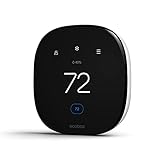
This is a comparison of four thermostats worth considering in 2026 – the Ecobee Enhanced (our top pick), Nest Thermostat 4th Gen, Honeywell Home T9, and Ecobee Essential. Different use cases, different price points.
Quick Picks
- Best overall: Ecobee Enhanced – room sensors, Apple Home support, solid app
- Best budget: Nest Thermostat 4th Gen – learning schedule, works with all major platforms
- Best for multi-room homes: Honeywell Home T9 – room sensor occupancy detection
- Best entry-level Ecobee: Ecobee Essential – same platform, lower price
Are Smart Thermostats Worth It?
Every smart thermostat page on the internet repeats the same number: install one and cut your heating and cooling bill by 20%. Nest has used a figure in that range for years, and ecobee, Honeywell, and pretty much every retailer selling these things repeats it back. There’s a problem with that number: the researchers who built the government’s own thermostat certification program said, in their own published paper, that no accepted method existed to check whether it was true. Connected thermostats were already running HVAC systems in more than four million homes when the EPA and Lawrence Berkeley National Lab admitted they had no way to verify the claim they were building a certification standard around. The stakes are bigger than one appliance category: residential thermostats govern something close to 10% of national energy use, according to the same research.
So what do the actual measurements say? Less than 20%, with a lot of variation – and a real chance of zero.
What Field Studies Found
The best long-term data comes from a Florida Solar Energy Center study that tracked 25 Nest thermostats (plus two Lyric units) in real homes across central and south Florida from 2013 to 2016. Of the 22 Nest installations that produced usable data, average savings landed at 9.3% on cooling and 9.5% on heating – roughly half the vendor number, and well below the 11.3% Nest itself had claimed in an earlier California sample.
Seven of those 22 homes saw their energy use go up, not down. Some already had a programmable thermostat running a tight schedule before the Nest arrived, so there was no slack left to capture. Others had owners who’d been managing a manual dial aggressively enough that a learning algorithm had nothing left to teach them. A smart thermostat can only save you money by beating whatever you were doing before – and plenty of people are already doing fine.
Two utility evaluations found the same gap on a larger scale. In 2018, an independent review of ComEd’s Illinois smart thermostat rebate program measured cooling savings of about 2% for participants – against the 8% figure the state’s own efficiency rulebook had assumed for years. The evaluators recommended cutting the assumed number to match reality; regulators hadn’t reached consensus as of the report, so the higher figure stayed on the books. And a 2015 Cadmus Group study of roughly 700 Indiana homes on an instrumented Nest program found a split result: heating gas use dropped 12.5% with a Nest versus 5.0% with a standard programmable thermostat, but cooling savings were nearly identical between the two (13.9% vs. 13.1%). The same study found 51-78% of programmable-thermostat households were manually overriding their programmed schedule – which is exactly the kind of slip a smart thermostat’s auto-away and geofencing catch and a programmable one can’t.
The Freshest Numbers Aren’t Better
The newest data point is also the largest. Energy Trust of Oregon published a billing analysis in November 2025 covering 13,762 gas-heated homes that installed a smart thermostat between 2019 and 2023. Measured savings averaged 22 therms a year against an expected 39 therms – a 56% realization rate. Brand didn’t move the needle much: Nest households saved 20 therms, ecobee households saved 22, and the study found no statistically significant difference between them. If you’ve been choosing between the two based on which one saves more energy, flip a coin.
Even the ENERGY STAR label is a lower bar than the marketing suggests. To earn it, a connected thermostat needs an aggregated field-data score showing at least an 8% reduction in heating runtime and 10% in cooling runtime – not household energy use, HVAC runtime specifically, averaged across climate zones. That’s the actual government-verified threshold these devices clear. It’s well below 20%, and it’s runtime, not your electric bill.
A self-installed subset of the Oregon cohort – no contractor, no professional load calculation, just a homeowner and a screwdriver – saved 15 therms in 2020 and 23 therms in 2023. Energy Trust’s own report won’t call that a trend given how wide the error bars are on a sample that size, but it does mean a DIY install isn’t the thing standing between you and these numbers.
Does the Thermostat Itself Use Power?
One objection worth killing off directly: does a smart thermostat’s own electronics, screen, and Wi-Fi radio eat into whatever it saves on the HVAC side? Barely. Across all 115 models currently on the EPA’s ENERGY STAR certified list, standby draw ranges from 0.02W to 2.59W, averaging 0.83W. Run that at the average for a full year and you’re looking at about 7.3 kWh total – a rounding error against any of the HVAC numbers above. Whatever a smart thermostat costs you in HVAC runtime it doesn’t win back, it isn’t losing it to its own screen and Wi-Fi radio.
Why So Many Owners Never See Any of It
Here’s the part that undercuts the savings pitch before you even get to the numbers above: most people who own one of these things don’t use the feature that saves money. The Energy Information Administration’s 2020 Residential Energy Consumption Survey found that 53% of U.S. households used some kind of programmable or smart thermostat – but only about 10 percentage points of that were internet-connected “smart” models with app control or a learning algorithm. Roughly 42% were plain programmable thermostats – the kind with a dial and a schedule you set once and never touch again. A lot of “most homes already have a smart thermostat” claims are blending those two very different categories together.
Worse: the same survey found that only one-third of households with a programmable or smart thermostat actually use the scheduling or automation features to control temperature. The other two-thirds leave it running like an old-fashioned dial, nudging the setpoint by hand whenever they’re too hot or too cold. None of the savings numbers above apply if that’s how you use one – you’ve just bought an app-controlled version of the thermostat you already had.
So, Worth It or Not?
A smart thermostat is a tool, not a guarantee. If you’re replacing a manual thermostat that nobody in the house adjusts correctly, or a programmable one that’s been sitting on factory defaults since installation, the savings above are realistic and worth chasing. If you already run a disciplined programmable schedule and never touch it, you’re buying remote access, room sensors, and a better app, not a lower bill. Both are legitimate reasons to buy one. Just build the schedule or turn on geofencing after it’s installed, because the hardware doesn’t save you anything sitting there being smart at nobody. And treat any vendor’s flat percentage as a starting estimate to verify against your own utility bill after a full season, not a number to bank on before you’ve bought anything.
One thing the field studies above don’t isolate for: room sensors. The Florida study ran on base Nest hardware in 2013-2016, years before Nest sold an add-on temperature sensor at all, and none of the utility evaluations above break out results by whether a household added one later. That’s the gap the Ecobee Enhanced and the Honeywell Home T9 are built to close – if the room where people spend their evenings runs three degrees off from wherever the thermostat’s bolted to the wall, a sensor-equipped model corrects for that specifically, on top of whatever the scheduling algorithm is already doing. Nobody’s published a field study measuring it, but it’s a separate problem from the ones the numbers above are answering.
Ecobee Enhanced
The Ecobee Enhanced is the pick if you want a thermostat that genuinely earns its keep. It ships with one SmartSensor in the box – a room sensor that detects temperature and occupancy, so the thermostat is heating or cooling based on where people actually are, not just where the thermostat is mounted. If your thermostat is in a hallway but everyone spends their evenings in the living room, this matters.
Platform support is comprehensive: Alexa built-in (the thermostat itself is an Alexa device, no hub needed), Google Home, and Apple HomeKit. Energy Star certified. The app is one of the better ones in this category – clear, functional, doesn’t require a PhD to configure a schedule.
C-wire required for full functionality, though Ecobee includes a Power Extender Kit for systems that lack one. Works with most 24V heating and cooling systems.
Nest Thermostat (4th Gen)
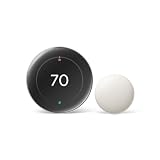
Google’s latest Nest Thermostat is a genuine upgrade over the 3rd Gen – better display, faster processor, and the addition of Apple Home support (finally). The learning algorithm watches your manual adjustments for the first week or so and builds a schedule around them. If you have consistent routines, it handles scheduling automatically without you touching the app.
The price is the main appeal here. It consistently runs $50-80 cheaper than the Ecobee Enhanced, and for most households the functionality difference is not worth that gap. The main trade-off is that it does not come with a room sensor – you get the thermostat’s location only, not multi-room sensing. Add-on Nest Temperature Sensors are available but sold separately.
Requires either a C-wire or the Nest Power Connector (included in the box). Works with most standard HVAC systems.
Honeywell Home T9
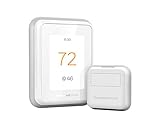
The T9 is Honeywell’s answer to the multi-room problem. Like Ecobee, it supports room sensors – Honeywell calls them Smart Room Sensors – that detect both temperature and occupancy. The thermostat prioritizes occupied rooms in its temperature decisions, which is the same core idea as Ecobee’s SmartSensors.
Platform support covers Alexa, Google Home, and Apple HomeKit. Geofencing via the Honeywell Home app works reasonably well – the thermostat can shift to Away mode when your phone leaves a set radius and return to Home mode when you get back. C-wire required, no workaround included.
The T9 is a solid choice for multi-room sensing at a price point that often comes in below the Ecobee Enhanced, though the Smart Room Sensors are sold separately at around $30 each, which can close that gap quickly if you buy a few. For the complete Honeywell lineup, including the budget T6 Pro and mid-range RTH9585WF, see our dedicated guide.
Ecobee Essential
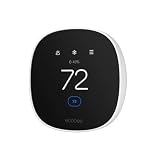
The Ecobee Essential is what you buy if you want to be on the Ecobee platform without paying for features you will not use. It drops the built-in speaker (no Alexa on the device itself) and does not include a SmartSensor in the box. What you do get is the same app, the same scheduling engine, the same platform integrations (Alexa, Google Home, HomeKit), and the same compatibility with Ecobee SmartSensors if you want to add them later.
SpaceIQ is Ecobee’s phone-based occupancy sensing – it uses your phone’s location, not a dedicated room sensor to make temperature decisions. It works, but it is a step down from having actual sensors in rooms. Still Energy Star certified.
C-wire or Power Extender Kit required. Best for: someone who wants Ecobee reliability and the option to add sensors later, without paying the Enhanced price upfront.
The Bottom Line
The Ecobee Enhanced is the right pick for most people. The included SmartSensor makes a real difference if your home has rooms that heat and cool unevenly, and the platform support is the most complete of any thermostat on this list.
If you are budget-conscious and have consistent routines, the Nest Thermostat 4th Gen gets the job done for less. The learning algorithm is genuinely good and the addition of Apple Home support removes the only major objection to the previous generation.
The Honeywell T9 makes sense if you want multi-room sensing and are shopping on price – just factor in the sensor cost if you plan to use them. The Ecobee Essential is the entry point to a platform that scales well.
One compatibility note: all four of these wire into central, ducted HVAC – none of them work on a ductless mini split or window unit; see our Sensibo review for that setup.